Proposed Label Would Allow Consumers to Compare Sustainability of Food Items
Researchers in France say the label would grade foods’ environmental footprint based on its farming practices, biodiversity impact and effect on climate change.
Consumers will one day be able to quickly choose among the food products sold on supermarkets’ shelves based on their environmental impact.
Researchers in France have created the Planet-Score front-of-pack label (FOPL) that rates food items based on their farming practices and impacts on biodiversity, animal welfare and climate change.
The creation of such logos is essential to inform the population, especially because (the environmental impact), depending on the food, is less intuitive for the general public than its nutritional qualities.
In a report sent to the French government for evaluation, the creators of Planet-Score explained that the FOPL represents a viable answer to the growing interest shown by consumers regarding the impact of food production on the environment.
See Also: Pilot Project Will Test New Eco-Label for European Food PackagesThe researchers hope that the new label will be adopted in France by the Ecological Transition Agency (ADEME), which recently put out a call for these types of labels to be created. Ultimately, the researchers hope the labels will be adopted throughout Europe.
While previous eco-labels have highlighted the environmental impact of a specific product, Planet-Score will allow consumers to compare the different environmental impacts of different types of food items.
For example, the researchers said a fruit juice could be compared to other fruit products or dairy and meat products.
“The creation of such logos is essential to inform the population, especially because [the environmental impact], depending on the food, is less intuitive for the general public than its nutritional qualities,” Emmanuelle Kesse-Guyot, a nutritional epidemiologist at the Sorbonne Paris Cité and the research director of the French National Agricultural Research Institute, told Olive Oil Times. She has not been directly involved in the development of Planet-Score.
According to its creators at the French Institute of Organic Agriculture and Food (ITAB), formulating the Planet-Score rating system has been challenging due to the complexity of all the data – sourced from the Agribalyse database – used to determine the scores.
Previously using Agribalyse, ADEME classified thousands of food products based on their environmental impact. However, ITAB officials said some of its dataset characteristics have to be corrected to use in Planet-Score.
“To design a logo, it is necessary that the data used to build it is very robust and takes into account all the parameters related to environmental pressures,” Kesse-Guyot said. “The current state of the scientific data allows very correctly to consider the carbon footprint of diet. However, for other impacts, it is much more complicated.”
ITAB is working with Sayari and the Very Good Future research organizations to re-frame the data available from a broad set of sources and implement new indicators to determine the aggregate score of food and production systems for Planet-Score.
According to Planet-Score’s proponents, the current ADEME methodology based on life cycle assessment does not sufficiently consider the wide range of elements needed for such a label.
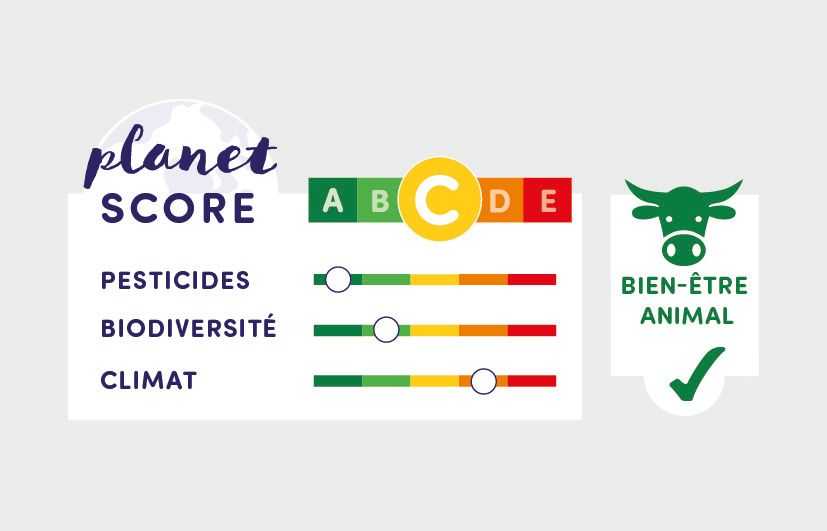
Photo: Institute of Organic Agriculture and Food
Among the most critical issues in delivering such a score is the rating of food’s impact on biodiversity.
“Biodiversity is an issue that cannot be left aside, and current knowledge does not allow this notion to be linked to food,” Kesse-Guyot said.
The ITAB researchers confirmed that biodiversity “is very poorly taken into account” by the current evaluation approaches. Biodiversity’s major drivers, explained the researchers, are habitat fragmentation, climate change, pollution, overexploitation of species and invasive species.
The researchers wrote that the data needed to evaluate a food item’s Planet-Score properly would also have to consider animal welfare, pesticide use and waste generated from food production and consumption. All of those have to be integrated into the final homogeneous rating scheme.
Planet-Score will also present a summarized rating based on a five-letter colored scheme, with the “Green A” representing the best score and the “Red E” the least one.
The idea of the new Planet-Score has been welcomed by some Italian olive oil producers, many of whom have previously opposed other labeling schemes, such as the Nutri-Score. Created in France and now used in several European countries, Nutri-Score is a FOPL focusing on the nutritional profile of food rated with an A-to-E colored scale label.
Organic olive oil is likely to receive a high rating from Planet-Score as olive trees are very effective at sequestering carbon dioxide and traditional olive groves may be cultivated to restore biodiversity to certain habitats.
“We welcome all policies that can help guide and educate the consumer towards conscious choices which can defend the planet,” said Anna Cane, president of the olive oil group within the Italian Association of the Oil Industry (Assitol).
However, she added that “we must make sure that a new potential FOPL can be easily understood by the consumer and that the rules it is based on are harmonized among the interested countries.”
“If that were not to happen, we could generate confusing labels, which already happens with other food logos that create more complexity for operators while not fulfilling the goals to which they were directed,” she continued.
Kesse-Guyot said that an additional challenge is introducing Planet-Score with an inclusive approach, given the complexity of the data involved and the different robustness of the datasets used to determine such a score.
“For the implementation of such logos, it is crucial it should not be done too quickly at the risk of leaving out the less documented elements,” she said.
However, Planet-Score already has been welcomed by several non-governmental organizations and environmental groups.
On its website, ITAB researchers highlight how their proposal is to be considered a first step. They hope the French and the international science community will help further develop the score to achieve a “sustainable food transition.”
“We consider Planet-Score a formidable tool to lead towards a more conscious approach to the whole ecosystem of farmers, producers, transformers and distributors,” ITAB researchers concluded.
- French Institute of Organic Agriculture and Food
- Agribalyse
- French Institute of Organic Agriculture and Food