



In Slovenia, the "Tree Needs to Look Beautiful"
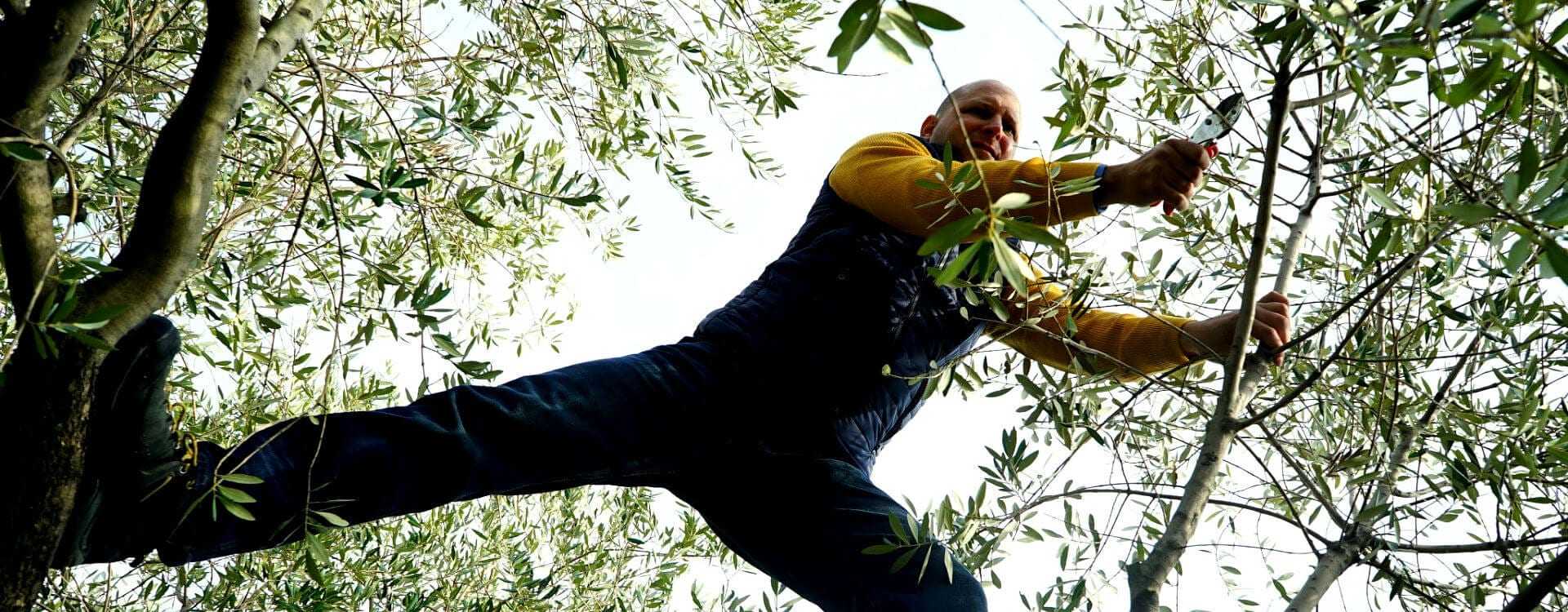

Miha Jakovcic fell in love with olive oil through his wife’s family in Slovenia, leading him to create Giuliana olive oil and revive olive production in the region. Despite Slovenia’s small size, its diverse climates and landscapes are contributing to the growing recognition of high-quality Slovenian olive oils, with Giuliana’s oil winning a Gold Award at a recent competition.
“There was a time when a squirrel could travel from Koper to Portoroz jumping from one olive tree to another,” Miha Jakovcic recalls “nonno” Giovanni, his wife’s grandfather saying, as he looks at the magnificent vistas from one of his olive groves in the hills of the Slovenian coast.
My wife’s father says that pruning is not just a matter of cutting the right branches. The tree needs to look beautiful as well.
Most of the slopes are now covered by forests. Some olive groves scattered here and there.
“That would be impossible nowadays, but if you look carefully, you can still distinguish the ancient terraces where olive trees used to grow beneath the oaks,” he says.
He comes from the same country, but until that moment, his relationship with olive oil had been a distant one.
Despite being a relatively small country — its area of 23,000 square kilometers roughly equals that of New Jersey — Slovenia boasts a large diversity of climates, landscapes and cultures.
Originally from Ljubljana, Slovenia’s capital city, Miha fell in love with olive oil thanks to his wife and her family and decided to create Giuliana olive oil.
It takes just one hour’s drive to switch the Mediterranean towns of the coast — with their distinctive Venetian-influenced architecture — for the Central European flavor of Ljubljana, featuring a rich Austro-Hungarian heritage.
“I consumed olive oil, sure, but it was from the grocery store. When they showed me how true, very good olive oil should taste and smell, it was a totally different story for me. And I fell in love with this tree,” Miha says.
Although he works full-time in finance and lives in the capital, he enjoys getting “full of energy” after a day of work in his olive groves.
“Do you think the branches are even?”, he asks as he climbs one of the olive trees to prune it better. “My wife’s father says that pruning is not just a matter of cutting the right branches. The tree needs to look beautiful as well,” he suggests.
Farming as a hobby or a second job, Miha’s case is not much different from other olive oil producers Olive Oil Times has visited in Slovenian Istria.
In this region, most producers own small, often disperse, properties spread on the steep slopes of the hills. For years, olive oil was produced only for self-consumption. That was also the case of Miha’s family until recently.
Now, he takes care of the land of his wife’s parents, four plots of land from Koper to Portoroz, and has managed to add the production of three other relatives under Giuliana’s brand, named after his wife’s mother.
They farm around 800 olive trees in total. Step by step, Miha says, oil production is recovering in Slovenia and many of the once-abandoned terraces and olive groves are being brought back to production.
“There is a saying in this area: A vine is like a lover. If you neglect it, even a little, it won’t forgive you. An olive tree, however, is like a mother. You can always come back to her,” he jokes.
Slovenia has just 46 kilometers of coast and produces around 400 tons of olive oil each year, according to the International Olive Council.
This is a small share of the Mediterranean production, however, the quality of Slovenian oils are gaining steady recognition. Last year, three Slovenian producers were awarded at the NYIOOC World Olive Oil Competition.
Giuliana’s olive oil won a Gold Award. For Miha, the special conditions of the Istrian climate and the fact that most of the farming has to be made by hand are keys to quality.
“Each plot is unique and needs special care,” he says, remarking how height, humidity and exposure to winds, low temperatures and sun may influence the way olive trees grow and the amount and quality of the harvest.
“We take care of each tree individually. We pick the olives mostly by hand and we harvest very early in October. We have to make a trade-off between excellent quality and larger quantity,” he says.
Related Articles
Apr. 14, 2025
Over 200,000 Olive Branches Donated for Palm Sunday Mass
In preparation for Sunday's celebrations in St. Peter's Square, hundreds of thousands of olive branches were gathered from groves throughout Lazio.
Aug. 26, 2025
Family-Run Olive Oil Business Thrives in Central Italy
Alfredo Agostini's small olive press in central Italy has grown into a thriving family business, exporting award-winning extra virgin olive oil worldwide.
Jul. 1, 2025
Torres Family Expands Legacy With Award-Winning Results
Since the fifth-generation winemakers began crafting extra virgin olive oil from centuries-old trees, their commitment to quality has been consistently recognized with numerous awards.
Feb. 6, 2026
Accademia Olearia Builds on Sardinia’s Heritage with Quality-Driven Growth
The Sardinian producer is increasing plantings across five municipalities and updating its milling line, while maintaining wide grove spacing and circular reuse of byproducts.
Aug. 5, 2025
Discover the Versatility and Nutritional Value of Greek Rusks
Paximadi, comprising carbohydrates and fiber, is the unsung hero of Greek summer cuisine, the key ingredient to making healthy small meals in no time.
Oct. 3, 2025
Monini Builds on Italy’s Olive Oil Legacy with Modern Investments
Rooted in Umbria and fresh off four Gold Awards at the 2025 NYIOOC, Monini is marrying heritage with modern farming, planting 800,000 olive trees to safeguard Italy’s olive oil supply.

Nov. 11, 2025
The Mission to Preserve Traditional Table Olive Recipes
Three researchers and communicators launched the Olives Around the Table initiative to collect traditional recipes from 20 Mediterranean countries for a digital archive.
Aug. 11, 2025
First 'Olive Oil Community' Established in Menfi, Sicily
An initiative promoted by Città dell’Olio aims to build networks of local institutions, economic operators and cultural entities linked to extra virgin olive oil.