Machine Improves Yield in Trial Runs by Hitting Olive Paste With Electricity
A new machine to improve yield fits into the standard olive oil production line, demonstrating that technology has a role in the development of the sector.
The agriculture sector is well on its way toward a third revolution and technology is the driving force.
We have confirmed the results and the yield of our olive oil increased by four to six percent. We also have a significant increase in polyphenols, between 100 and 150 ppm.
Simon Blackmore, an engineer at Harper Adams University in the United Kingdom told the journal Nature, that all types of different technologies are increasing small farmers’ production capacities and cutting costs.
“We can make crop production significantly more efficient and more sustainable,” he said.
OliveCEPT, a machine that provides an additional step in the olive oil extraction process, is among these new technologies that many in the sector are hopeful will lead to higher olive oil yields at lower costs for both small-scale and large-scale producers.
According to Johan Möllerström, the CEO of the Swedish company that has designed and launched OliveCEPT, the new technology that helps producers maximize their yields by adding another step to the standard olive oil production line.
“The traditional extraction process will not get all the oil out of the olive paste,” Möllerström told Olive Oil Times. “We are increasing the efficiency of the process.”
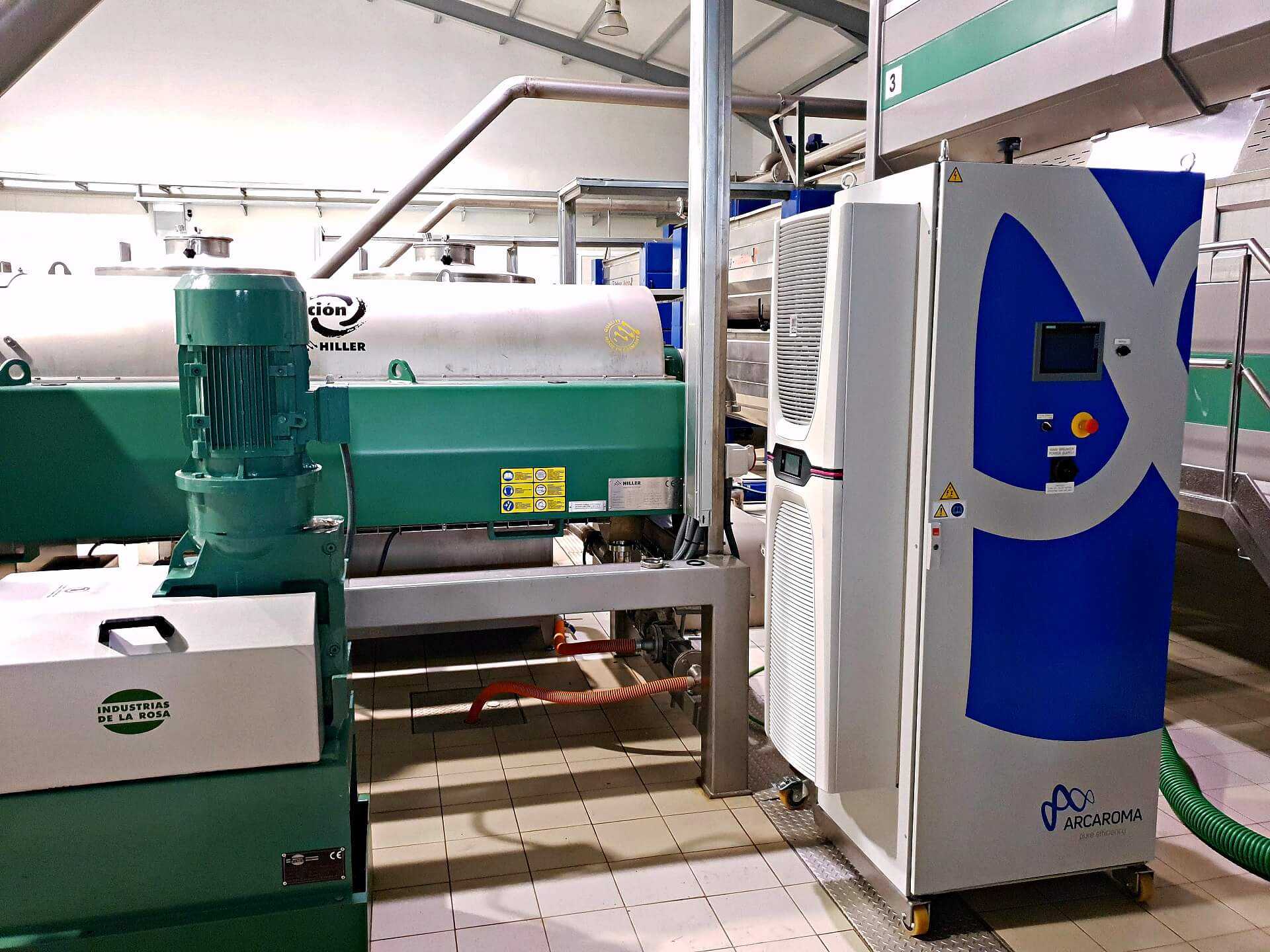
OliveCEPT is a machine looks like a large white rectangle standing on one end, with Arc Aroma’s blue logo painted on the side and four swiveling wheels at the bottom. The technology is currently being tested by ten producers in Greece, Italy, Morocco and Spain.
“We are very confident that we are providing benefits to the client,” Möllerström said.
The machine, which he touts for its energy efficiency, runs day and night during the harvest and is inserted between the malaxing and extraction steps. Olive paste from the malaxer enters one side of the OliveCEPT, which breaks down the cell walls of the olive flesh, releasing more oil that then flows into the extractor.
“We are doing that with the technology of pulse electrical fields,” Möllerström said. “That means that we are creating a voltage and electric field in the chamber. When we are doing that we attract particles in a sediment grain and break down the cell walls, which maximizes the oil yield.”
Möllerström claims that the technology increases oil yields anywhere from five to 15 percent and, so far, the results have borne his claim out.
Maurizio Servili, a professor in the Department of Agriculture, Food and Environmental Sciences at the University of Puglia, has worked on the project with Möllerström from the beginning. He said that in tests run by the university, OliveCEPT has increased yields by five percent.
“The impact of the pulsed electrical field technology applied to the olive oil mechanical extraction process showed a significant impact on extra virgin olive oil yield,” he said. “The yield increase was determined to at least five percent compared to the reference extraction where the pulsed electrical field technology has not been applied.”
Emilio Conti, the quality manager at Frantoio Conti, praised the technology in a YouTube video, highlighting both the increased quantity and quality of his yield, in terms of flavor profile, polyphenol content and aesthetics.
“We have confirmed the results and the yield of our olive oil increased by four to six percent,” he said. “A better quality of our oil is extracted as it increases the color of the oil, so if we have a green, it is more intense green. If we have a yellow it’s more intense yellow.”
“As for the fruitiness, it increases by about one point,” he added. “We also have a significant increase in polyphenols, between 100 and 150 ppm.”
Möllerström said that increasing polyphenol counts was not exactly what OliveCEPT was meant to do, but is a welcomed side effect of the process.
“This is a positive side effect of the treatment of getting more olive oil out of the process,” he said. “We thought we would have that. You never know, but we are glad we had this type of side effect.”
While OliveCEPT is only now being used in a limited manner across the four aforementioned countries, Arc Aroma has also been testing the product in the Southern Hemisphere, with trial runs taking place in both Argentina and Chile.
After four years to tweak the product, Möllerström said that he was getting positive feedback and will continue looking for clients, both large and small.
“I think we are creating great value for olive oil extraction customers,” he said. “It’s quite a low investment and a short payback time for the technology.”
Arc Aroma also uses similar technology in wine, beer and juice production.