



How Cold Temperatures Can Help Olive Production
Very low temperatures and snow can have positive effects on olive trees by reducing the olive fruit fly population, containing fungal diseases and aerating the soil.
 5.4K reads
Unusually low temperatures and snow have affected olive oil production areas in Italy, Greece, and Croatia, with snowdrifts whitening Apulian olive groves at sea level. The cold weather can have positive effects on the development of olive trees, reducing the olive fruit fly population and containing fungi, but precautions must be taken to prevent damage to the trees.
Over the past month, olive oil production areas such as Italy, Greece and Croatia were affected by exceptionally low temperatures and snow at low altitudes. Apulian olive groves at sea level have been whitened by snowdrifts for days.
An undoubted advantage of low temperatures and snow is the reduction of the olive fruit fly population.
Italy registered unusually severe winters in 1929, 1956 and 1985 that caused damage to the olive sector and agriculture generally. The cold can affect the wood of olive tree if the minimum temperature drops below ‑7°C (19.4°F) for 8 – 10 days, and cause irreparable harm to the canopy and trunk if they fall below ‑10/-12°C (14/10.4°F) in a few hours.
In broad terms, it is preferable to choose native varieties for their ability to adapt to soil and weather conditions in their region of origin, and a few days under the snow can have positive effects on the development of an olive tree and its production. It is not without reason that an old rural Italian proverb says in rhyme, Sotto la pioggia, fame; sotto la neve, pane, which means “Under water, famine; under snow, bread.”
“This winter was generally very cold with widespread frosts and snowfalls in large areas of the country,” said Nicolangelo Marsicani, an experienced olive grower from Campania which manages 6,000 olive trees in Sicilì di Morigerati, located in the National Park of Cilento, Vallo di Diano and Alburni.
“The cold is critical to allow a period of vegetative rest and positively impact the development of the olive tree. Alongside fewer daylight hours and less time for photosynthesis, the period of dormancy due to low temperatures promotes flowering.” In fact, last winter in Italy temperatures did not decrease enough in several areas, and this was blamed for a drop in production.
“An undoubted advantage of low temperatures and snow is the reduction of the olive fruit fly population,” Marsicani observed. In late fall and winter, most of the last generation’s larvae leave the olive and pupate in the soil; their vitality is undermined at around 0°C (32°F) and a high mortality rate can be registered if temperatures drop below ‑5/-6°C (23/21,2°F) for some days, especially for those lying in the top layers.
A further benefit given by cold weather is the containment of fungi. “Diseases such as Peacock spot, which is caused by the Spilocaea oleaginea, are often overlooked,” our farmer considered. “However, when damaged leaves fall, the decreased photosynthetic surface will affect development and production. The cold is a good ally in preventing the spread of this kind of disease.”
Moreover, the expansion of water upon freezing (by approximately 9 percent) causes microcracks which aerate the soil just like it was tilled. If frost lasts for several days and the process of thawing is slow, this will provide a good water reserve, without runoff of organic substance.
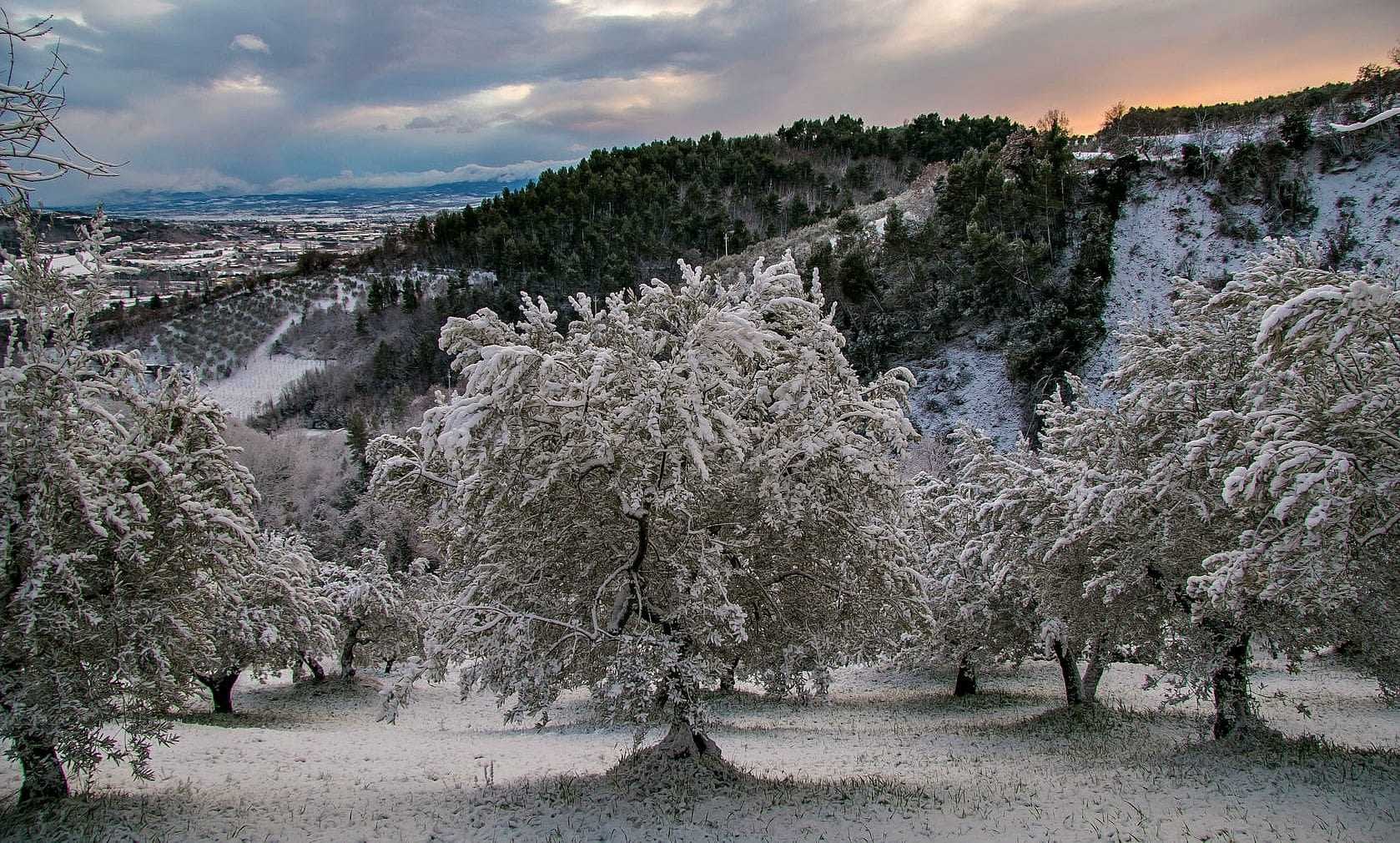
“In any case, we must be careful that too much snow does not overburden the secondary branches since fractures can facilitate the penetration of Pseudomonas savastanoi in more susceptible varieties,” Marsicani concluded.
As soon as temperatures go back to normal and the ground and the olive trees are dry, we can return to the olive grove and start again with the appropriate agricultural practices like pruning.
Related Articles
Jun. 28, 2025
Family's Love for Italian Cultivar Shapes Generations of Success
The Carroccia family-run olive farm in central Italy produces a celebrated Itrana monovarietal, rooted in love for the unique cultivar and its connection to the 'village of longevity.'

Nov. 7, 2025
EU Submits 2040 Climate Goal Ahead of COP30, Targets 90% Emissions Cut
The European Union has submitted its updated climate plan to the United Nations, pledging to cut greenhouse gas emissions by 90 percent by 2040 compared with 1990 levels.

Oct. 29, 2025
Monte Rosso: A Family Dream Reborn on Istria’s Red Hill
On Istria’s Red Hill, Davor Duboković and his partners turned abandoned land into one of Croatia’s most advanced olive estates.

Jan. 28, 2025
Moroccan Producers Face Third Straight Year of Declining Production
Olive oil production is expected to fall to 90,000 metric tons, resulting in rapidly rising prices and fears of a shortage.

Jul. 23, 2025
PDO and PGI Tourism Boosts Olive Oil Industry in Italy
Report highlights the growing trend of sustainable tourism in Italy, creating new opportunities for producers and promoting the country's unique regions.
Nov. 26, 2025
Global Olive Oil Production Hits Record 3.5 Million Tons
A new report forecasts global olive oil production at a record 3.507 million tons for 2024/25, driven by strong recovery in Spain and rising output in non-EU countries.

Dec. 5, 2025
Archaeologists Uncover Massive Roman Olive Oil Complex in Tunisia
Archaeologists excavating Henchir el-Begar in central Tunisia have uncovered one of the largest olive-oil production complexes of the Roman world, complete with monumental beam presses.
Mar. 28, 2025
Filippo Berio Execs See Equilibrium Returning to The Global Olive Oil Market
A harvest rebound in Spain and strong harvests elsewhere, have resulted in falling prices at origin and portend a decrease in retail prices, say Berio officials.