Award-Winning Olive Oil Producer Thinks Weed Control Is for the Birds
A young Spanish olive oil producer has decided to try using geese as weeders in his family´s olive groves. By doing so he not only hopes to keep down undergrowth, he also strives to promote the survival of an endangered Spanish goose.
Juan Olivares is a young olive oil producer from Castilla La Mancha, an area of Spain perhaps more famous for its cheeses than its olive oil. However, Juan´s family has been producing olives for at least five generations. I met Juan a few years ago taking a long series of courses at the University of Jaén to become an expert olive oil taster.
By learning to taste, he hoped to make his family’s award-winning olive oil Pago de Peñarrubia even better.
The delicate Arbequina he produces won a Gold Award at this year’s New York International Olive Oil Competition.
It was obvious from the moment we met that he was a person that was going to make a mark. So it came as no surprise when we spoke to Juan more recently that he had a very unique project starting in his olive groves.
He laughed as he told me that his geese are his babies. “Do you want to see them? I will send you pictures.” He spoke as if he were a new proud grandmother who just had her first grandchild. Of course, we wanted to see them!
Many groves use sheep and horses to keep undergrowth down between olive trees, but after reading some studies that were being done in the U.S. on the use of geese in agriculture, Juan decided that it was worth a try.
From ancient Egypt until the 1950s geese were used in agricultural practice. The Romans, the Chinese, even Charlemagne encouraged the use of fowl for weeding. Before the introduction of herbicides in the 1970´s there were geese.
Their light feathered bodies and webbed feet do not compact the soil like other livestock and they do not munch on lower tree branches or cause tree damage. Geese are also relatively easy to maintain and can offer other economical gains such as feathers, meat and eggs.
Juan was convinced. It was a cheap experiment. The most expensive element was building a fence. He had the perfect setting, an area in the older groves that was divided into three terraces that he now uses as three test plots. In the first terrace he implements the geese and compares the plot with the other two.
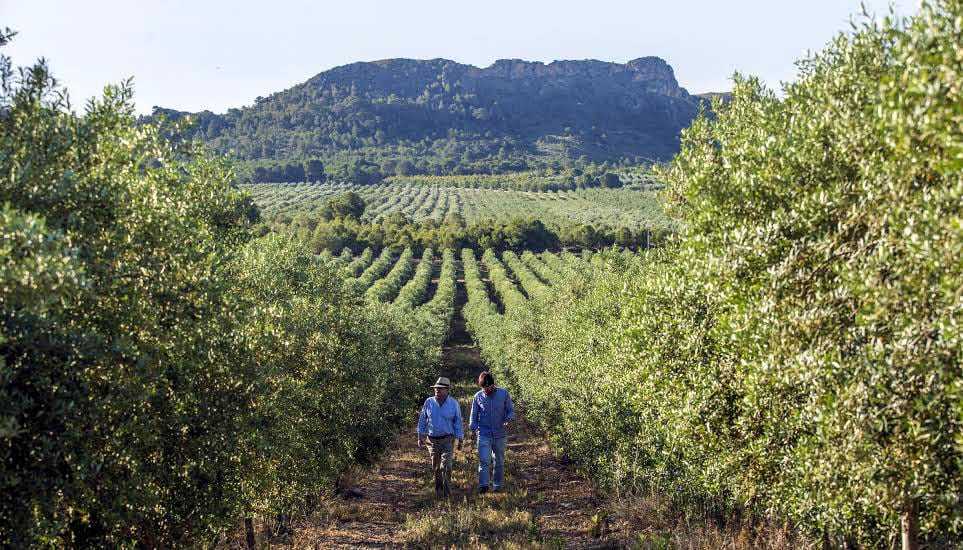
Juan and his father in the groves at Pago de Peñarrubia
He chose his geese wisely. It took him time to investigate and find the breed he wanted to use. In the end he opted for an endangered Spanish goose, Oca Empordanesa, whose use in agriculture he thought could also promote the biodiversity of a native species.
It was not easy to find a breeder. However, once he did, he bought 10 geese when they were still goslings. Now there are 9. One went missing and he believes it is possible that a predatory bird snatched it up.
They have just now become full-grown and Juan is hoping to be able to see some results in his test plots soon. Only time will tell if this young farmer is on to a new trend in olive oil farming.
Juan assures us that the geese are not always at work weeding. They also have a lovely pond where they splash about and spend their free time.