Croatians Celebrate a ‘High Quality’ Olive Harvest
Olive oil producers in Croatia are happy with their new batch of freshly-pressed oil and report that despite lower yields, oil quality is even better than last year.
As Croatian olive growers wind up the harvest season, many are attributing their lower crop yields to the hot and dry summer of 2017.
After a cold and dry winter in many parts of Croatia, an early spring brought the early blooming of olive blossoms in many regions. This was followed by a hot and dry summer season with drought-like conditions that provoked wildfires in parts of Dalmatia along the south Adriatic coast.
All is certainly not lost though, because producers are happy with their new batch of freshly-pressed oil and report that despite lower yields, oil quality is even better than last year.
See Also: The best olive oils from Croatia
“We harvested about 40 percent less than last year, but the quality is superb,” reported Roman Urbanija from his grove of close to 700 olive trees on the tiny Dalmatian island of Žižanj.
“The dry summer followed a very dry winter and spring during which we had almost no rain. Our groves were carpeted with little dry olives that wilted and fell from the trees, while those that survived were smaller than usual. But I must say that the quality of the olive oil is again very high,” he added.
Further south on the Pelješac peninsula, Ivan Miloš is celebrating a good harvest. “This year’s harvest was one of the best,” he told Olive Oil Times. “Due to an extremely cold winter and then an extremely hot and dry summer, we didn’t have any problem with diseases or the olive fly. So, even though we did have drought conditions for a while, we got lots of rain in early September, just in time to refresh our olive trees. We started picking on October 5th – which is quite early, and we finished in a week. It’s important to pick olives at the right moment so that we can get that perfect balance of fruitiness and robustness.”
Meanwhile on the island of Krk in the North Adriatic, the Jud family started harvesting two weeks earlier than last year, which had seen a particularly good harvest. Iva Prendivoj Jud of Utla Olive shared some of the challenges faced by producers on the island: “In our area there were very high temperatures at the time olive trees were blossoming so many producers lost a lot of their crop. Then the biggest challenge this season was drought during the summer. In our case, we have approximately 85 percent of last year’s harvest so the difference is not so big. But last year was an exceptional harvest year.”
Producers in the neighboring peninsula of Istria have just about completed their harvests and are reporting similar results: quantity is down but quality is up. Daniel Bellani of Terra Rossa reported that overall it was a good year: “The summer was hot and dry, but our red soil managed that very well. This year we harvested 30 percent less than last year. But that is not critical because last year was an extraordinary year. This year was again a normal one and we had no problems with viruses or insects.”
A certified olive oil sensory expert, Bellani confirmed that he’s more than satisfied with his family’s new batch of fresh olive oil: “From the sensory point of view, the new olive oil is full of green and fresh aromas and it has much less bitterness and pungency compared to the last few years. I would even say that the old olive oil still has even more pungency and bitterness compared to the new one. We expect that the new oil will achieve a better grade for ‘harmony.’ This will give us an even better rating at international competitions.”
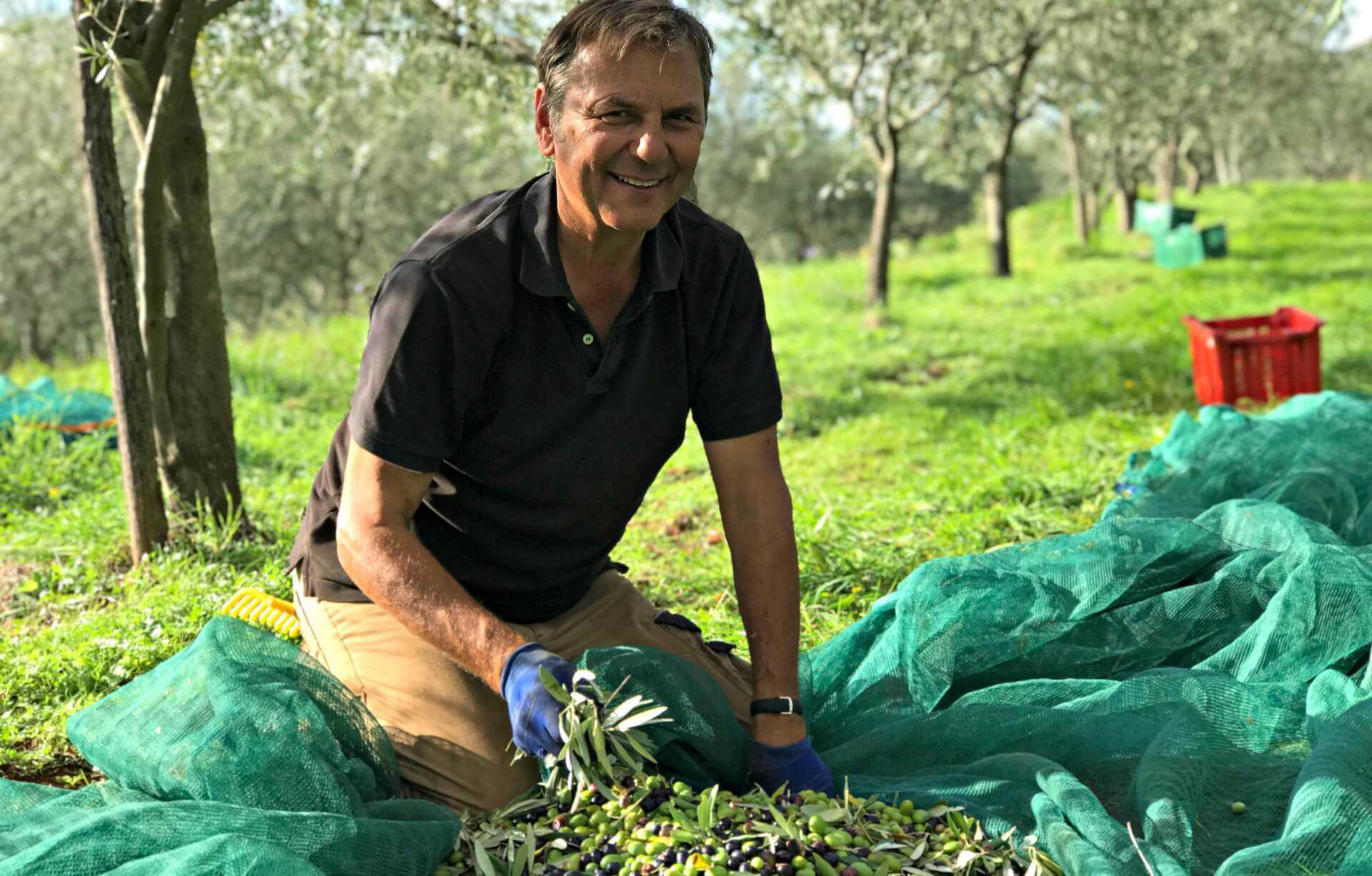
Stelio Bellani of Terra Rossa (photo by Daniel Bellani)
This past weekend, producers from across the region shared results and samples of their freshly-pressed oil at the 13th edition of the Festival of New Olive Oil in Vodnjan, where there was a record number of exhibitors.
For some local producers, the three-day festival provided a break from the harvest. “We’re still harvesting because we have to pick different varieties at different times,” explained Silvano Puhar of Brist, whose oils are popular with many gourmet chefs. “And I even pick some varieties twice: early and late, and then blend the oils together. Olives picked early are rich in polyphenols while those picked later have more of that bitterness that’s so sought after.”
Occupying one of the bigger corner stalls at the festival were the Chiavalon brothers whose namesake brand is one of the best-known of Croatia’s many high-quality olive oils. Their organic extra virgin olive oil is produced on the family’s farm in Vodnjan and shipped across the world to customers in the US, Japan, Singapore, Hong Kong and Taiwan.
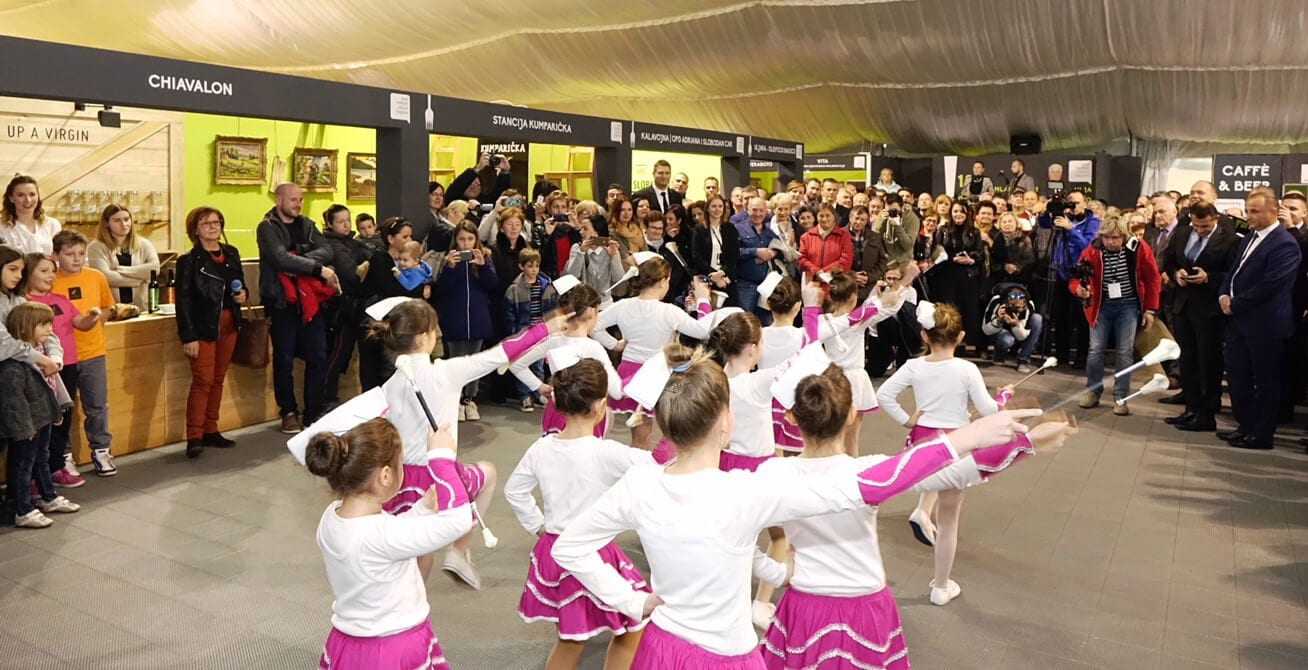
Children perform at the 13th Festival of New Olive Oil in Vodnjan
While Tedi poured tasting samples of their fresh new oil, his brother Sandi revealed that yield is up by 15 to 20 percent compared to last year. He attributed this to their younger trees that are producing a lot of fruit. “Thanks to the hot weather we didn’t have any problems with pests like the dreaded olive fly,” he added. “Usually during the summer I check on our trees every other day, but I know that as soon as temperatures climb over 37 (degrees Celsius) I can relax and head to the beach.”
Overall, Croatian growers have had a laid back season and a prolonged harvest. Press articles have reported that oil mills have not been working around the clock like last year when the threat of pests pushed growers to pick their olives as quickly as possible. However, a new challenge for many olive farms is the lack of manpower. Workers are increasingly hard to find and some producers have resorted to using mechanized tools instead of picking entirely by hand.
With the harvest just about over and producers satisfied with the high quality of their freshly-pressed oils, the focus for many will now be applying for international competitions. Croatian olive growers took home a record number of international awards in 2017. Quantity may be down this year but this has not sacrificed quality which will hopefully bring more awards in 2018.