Greek Painter Dedicates Athens Mural to the History of Olive Oil Production
In his latest work, Stelios Faitakib seeks to show the long and storied history of Greek olive oil production through a uniquely Greek medium.
With his dense and intense style of street art, painter Stelios Faitakib takes a penetrating look at domestic olive growing, using the vocabulary of the Greek Orthodox Church in his latest work: “The olive tree as a world symbol of sports, culture and peace.”
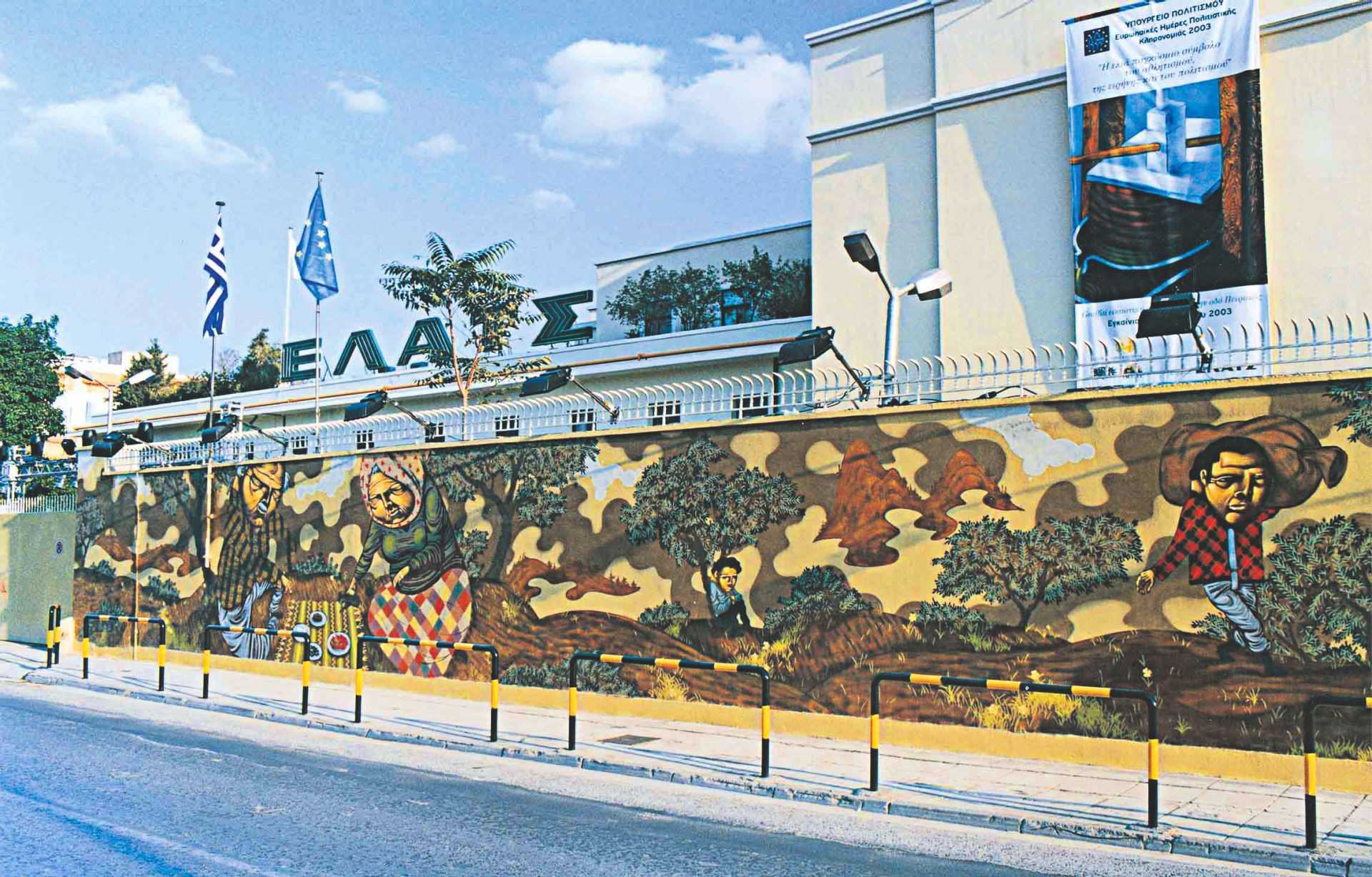
In the industrial zone of Piraeus Street, outside the Elais building – one of the biggest olive oil companies in the country and a patron of the work – his most recent creation is a huge mural that describes the history of olive production.
I could have done a group of workers laughing at some point but again the seriousness on their faces would prevail.
“The mural is divided into parts in a natural way with pauses, showing olives trees between episodes,” Faitakib said. “Starting from the left is the award of an olive wreath of the Olympics. Then Athena is shown competing with Poseidon, the god of the seas, for the patronage and protection of the city of Athens.”
Stelios Faitakib
“Workers pick olives, while to the right an elderly couple takes a break from work to eat a meal containing olives and olive oil,” he continued. “The mural takes a look at people working to press olives in an old, traditional olive mill.”
See Also: Second Wave of Covid Hampers Harvest in Greece“It was very interesting for me to capture the evolution of time in the making of olive oil,” Faitakib added. “Things are completely different now. Therefore I consider it good to illustrate the episodes of the making of olive oil in the succession of centuries.”
Part of what makes the mural standout in this historic city is its sheer size: the length is about 120 meters and the height between three and four meters. Both its size and location led to a unique series of challenges for the celebrated painter.
“The difficulties were precisely the size and location of the spot, in combination with the season (it was August),” he said. “The execution of the project was a great challenge. I woke up at 5:00 a.m. to be able to work in relatively good conditions in the morning. I could never, from what I remember at least, continue to work after 4:00 p.m. with the sun on my back and neck.”
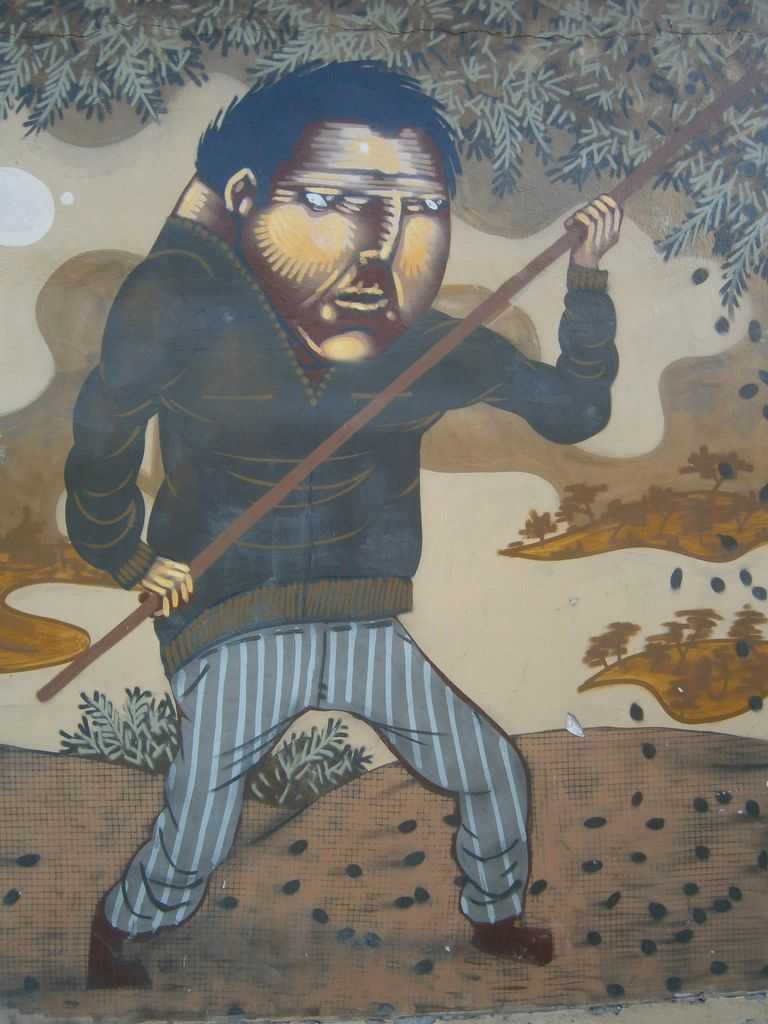
Mural by Stelios Faitakib
As with almost all of his work, Faitakib uses the familiar language of iconography of the Greek Orthodox Church to tell the story of the olive tree, which is also deeply rooted in Greek culture.
“I use iconography as the basis of my work in the same way that I would primarily use the Greek language if I were a poet,” he said. “I am interested in the fact that the visual ‘language’ I use is the language that indicates the origin of a work when one sees it in the world, as well as that it speaks to a wide audience.”
However, part of what helps Faitakib’s latest work stand out at home is the serious expressions of the people in his painting, which is juxtaposed with the more cheerful disposition of other Athenian street art.
“Olive production is quite tedious and demanding… at least that’s how it seemed to me when I did it,” Faitakib said. “I could have done a group of workers laughing at some point but again the seriousness on their faces would prevail.”