A Gold Standard Farm in Umbria Promotes Research on Sustainability and Health
Castello Monte Vibiano Vecchio won two Gold Award at NYIOOC 2017 thanks to constant research on quality and sustainability.
On a warm day of early June, we drove across the green heart of Italy and cherished the graceful profile of the landscape which surrounds Castello Monte Vibiano Vecchio.
People who lived here over the ages took care of this territory with love and respect. This is what we do today and the way to get the best from your land.
When I talked with Lorenzo Fasola Bologna about the two Gold Awards received at the 2017 NYIOOC, I felt his passion and desire to do better, even though some impressive goals have already been achieved by the Umbrian farm.
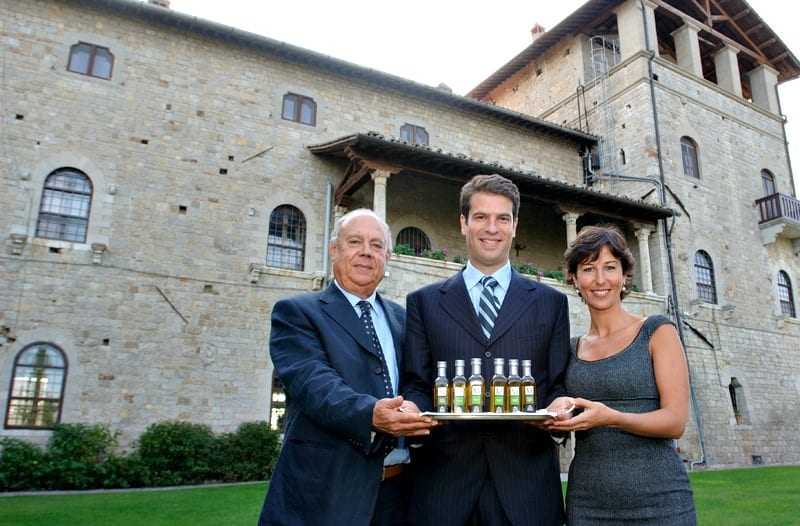
Andrea, Lorenzo and Maria Camilla Fasola Bologna
He joined his father Andrea Fasola Bologna in the management of the company in 1998 and they decisively took the path to sustainability with a number of measures which led to ‘360 green’ revolution. “We reduced the environmental impact and achieved the complete sustainability of production, enhancing both the quality of products and the quality of life of people and territory,” he pointed out, remarking that over the years, 10,000 trees of different types have been planted.

Vubia, by Castello Monte Vibiano Vecchio
In 2008 the company received the certification #00001 by the independent authority DNV, in accordance with the international standard ISO 14064, for cutting its greenhouse gas emissions. As the first farm to fulfill this target, they went from 287 tons to minus 764 tons of CO2 in a few years.
See Also: The best olive oils from Italy
Now, in addition to a special focus on sustainable phytosanitary management, they only use biodiesel-powered tractors and electric vehicles. Energy is produced by photovoltaics panels, while further energy-saving arrangements, like the implementation of albedo effect on roofs, allow to cut several tons of CO2.
“Today, sustainability is a trendy concept, but in those years our environmentally friendly attitude was groundbreaking,” Fasola Bologna told me. “We believe that this is the foundation of a healthy future, but above all the starting point for quality since I think that olive trees must grow in an environment as healthy as possible.”
We walked in the shade of a secular olive grove, along pathways that were once walked by Etruscans, who gave the name Vubia to the Roman clan that colonized the area. A wall from that time still stands as a border between olive trees and vines.
“The energy of this place seems to act on the products of the soil that are always excellent,” said Lorenzo’s sister, Maria Camilla Fasola Bologna. “And in fact, historical evidences enriched by legends tell us that people who lived here over the ages took care of this territory with love and respect. This is what we do today and the way to get the best from your land.”
From the origins of this place, they named Vubia the blend of Moraiolo, Leccino, Frantoio and Dolce Agogia which won a Gold Award, thanks to its excellent sensorial combination of artichoke, sweet almond and herbs with enjoyable bitterness and pungency.
The family earned another Gold Award for their Tremilaolive Monocultivar Borgiona, which is made up of a native variety and took its name from the number (tremila means three thousand) of olives typically needed to produce half liter of their extra virgin olive oil.
They can count on 14,000 olive trees, of which the most ancient are estimated to be about four hundred years old. Eleven different varieties including Moraiolo, Frantoio and Dolce Agogia, and other less common cultivars such as Rosciola di Panicale, Rosciola Umbra, Limona, San Felice, Pocciolo, Nostrale di Rigali, Borgiona and Capolga Umbra, give life to a unique ‘secular’ blend, characterized by notes of aromatic herbs.

A study carried out by the CNR of Perugia allowed Castello Monte Vibiano Vecchio to be among the first to use the DNA recognition for certifying extra virgin olive oil. “We receive a part of olives from small producers of this area,” Lorenzo Fasola Bologna explained. “They only cultivate local varieties according to our sustainable and certified approach, and we want to provide our consumers a verified quality assurance.”
They certify all their products, including a new frozen single-dose extra virgin olive oil. Tests showed that freezingextra virgin olive oil immediately after bottling keep it in excellent condition and promotes consumption. “We designed a single-dose as it gives the possibility to be used during a dinner, making you feel like the extra virgin olive oil just came out of the mill,” he said, suggesting its use with gazpacho and other fresh summer food.
Moreover, they carry out ongoing research activities on the properties of extra virgin olive oils and its byproducts, like a a concentrated liquid extract with Hydroxytyrosol, developed in collaboration with a team of researchers and doctors.
It is an extraordinary substance, whose many benefits are yet to be discovered, considered Fasola Bologna. “We developed this product to help prevent cholesterol and high blood pressure-related problems, to improve blood sugar control and take precaution for many other diseases,” he explained, highlighting the large number of researches that demonstrated the beneficial effects of this phenolic phytochemical on the reduction of oxidative stress.
“Some sportsmen use our food supplement and this make me proud,” he revealed. “A healthy lifestyle based on Mediterranean diet is the starting point to feel good!”
The sun goes down on the olive grove, while we enjoy a gentle evening breeze and the olive trees are in full bloom all around us.