Navarra’s Aceite Artajo Marries Cutting-Edge Tech with Centuries of Olive Oil Heritage
From smart irrigation and solar-powered cooling to trials with dozens of olive varieties, the family-run estate is blending innovation with heritage to produce award-winning organic extra virgin olive oils for markets at home and abroad.
In the fertile Ribera de Navarra, where the Ebro Valley stretches between the Bardenas desert and the snow-capped Moncayo, Aceite Artajo is getting ready for the coming olive harvest.
“After a difficult flowering period due to high temperatures, the harvest looks to be average, so we are satisfied and hope to maintain or improve the quality of last season’s extra virgin olive oils,” said Andrea Urzaiz Huguet, quality and marketing manager at Artajo.
In typical seasons, the harvest in Artajo’s corner of northwestern Spain lasts for a few weeks from the first days of October. Choosing the correct harvest time allows the farm to produce a wide range of olive oils.
Ribera de Navarra is one of the areas of the Iberian Peninsula with the most hours of sunshine per year… with a contrasting climate and great potential for producing aromatic character and balanced yields in our olives.
However, Urzaiz said her family has plenty of experience, with roots in the olive oil business dating back several centuries.
“The origin of Aceite Artajo dates back to the 18th century, when the Artajo family produced extra virgin olive oil in the historic center of Tudela, until the 1960s,” Urzaiz said.
“After a production hiatus in the 20th century, the olive-growing tradition was revived in 1998 with the planting of new olive trees at Los Llanos estate,” she added. “Later, in 2007, a modern oil mill was built to produce early-harvest extra virgin olive oils of the highest quality.”
See Also: Producer ProfilesAccording to the company, its focus on quality has opened doors to export to the United States.
Urzaiz cited the company’s track record of winning quality awards, including a Gold Award for a medium-intensity blend of Changlot Reial, Picual, Hojiblanca, Cornicabra and Picudo olives at the 2025 NYIOOC World Olive Oil Competition, as one of the reasons they were able to enter the lucrative North American market.
“The NYIOOC is always a good boost to all the effort that goes into betting on quality,” Urzaiz confirmed. “It is also very interesting commercially for the U.S. market.”
The farm is also expanding its sales to other areas. “We want to reach everyone. This product deserves it. It’s slow, but we’re finding very loyal customers,” Urzaiz said.
To fine-tune its modern production techniques, the farm conducted an extensive trial with more than 70 olive varieties, ultimately selecting 14 of them for the new groves.
“The ones best suited to the local environment and capable of producing top-quality oils were chosen,” Urzaiz noted, including Arbequina, Arbosana, Koroneiki, Manzanilla Cacereña and Arróniz.
Among the more recent experiments is the planting of Lecciana olive trees, a cross between Leccino and Arbosana, developed for resilience in a changing climate.
“For now, it represents a small area, and we planted it because it seems a promising variety for producing quality green fruity oils, and this is what we are looking for in Artajo,” Urzaiz said.
Today, Artajo cultivates more than 250,000 olive trees on 250 hectares.

Aceite Artajo has planted dozens of olive varieties, experimenting to see which ones will thrive in Navarre’s distinct climate. (Photo: Aceite Artajo)
“Ribera de Navarra is one of the areas of the Iberian Peninsula with the most hours of sunshine per year,” Urzaiz said. “It is one of the northernmost areas for olive cultivation, with a contrasting climate and great potential for producing aromatic character and balanced yields in our olives.”
According to the farm, its organic and regenerative approach shapes the company’s operations.
“Artajo embraced organic farming to protect the environment and produce healthy and safe food,” Urzaiz said.
However, adopting organic cultivation and production methods has come with a cost.
“Challenges are increased labor and costs,” Urzaiz said. “There is a popular belief according to which ‘organic’ is the same as ‘abandoned.’”
“It is quite the opposite. It’s about doing a lot of small things,” she added. “And the opportunities are product differentiation and meeting the growing consumer demand for sustainable and organic goods.”
“We are doing organic production to offer a quality product that also offers safety,” Urzaiz noted. “If that is valuable to the consumer, all the better.”

Aceite Artajo cultivates biodiversity by creating habitats for local insects, birds and bats as well as planting other native plant species around the olive trees to fortify the soil. (Photo: Aceite Artajo)
Artajo’s organic approach includes initiatives such as planting flower borders and creating insect hotels, amphibian ponds and floating islands in irrigation basins to encourage biodiversity.
Additionally, they have installed more than two dozen wooden nest boxes to attract birds and bats that help control pests naturally.
Terrace farming, cover crops and pruning residues protect soil structure and moisture while curtailing erosion.
According to Urzaiz, the olive trees capture carbon year-round, and vegetative cover improves soil organic matter, contributing to a negative carbon footprint.
Artajo has also adopted modern technology from the outset of the new cultivation, and today, weather stations and real-time moisture sensors enable smart drip irrigation.
“We rely on technology and precision agriculture to optimize resources such as humidity sensors. They tell us the status of each irrigation sector on the farm in real time,” Huguet said.
The farm is also using the Normalized Difference Vegetation Index (NDVI) to monitor the conditions of the olive trees across the estate.

The cooling system for Aceite Artajo’s tank room is powered by solar panels, helping increase the negative carbon footprint of the company’s olive oils. (Photo: Aceite Artajo)
Such monitoring supports precision agriculture interventions such as irrigation and fertilization. It can also show early signs of stress, allowing a prompt response.
Water drawn from the nearby Lodosa canal is stored in reservoirs and used strategically to ensure the correct amount of water for each tree.
Renewable energy powers much of the estate. Olive pits fuel a biomass boiler that supplies heating and hot water to the mill and other facilities.
“We also generate solar energy to pump irrigation and refrigerate the cellar,” Urzaiz said.
Such technology also strengthens the farm’s efforts to adapt to climate change, which tends to impact the volume of yields.
“In recent years, we’ve seen our harvests seriously compromised, whether due to extreme heat during flowering, periods of drought or rather extreme storms,” she noted.
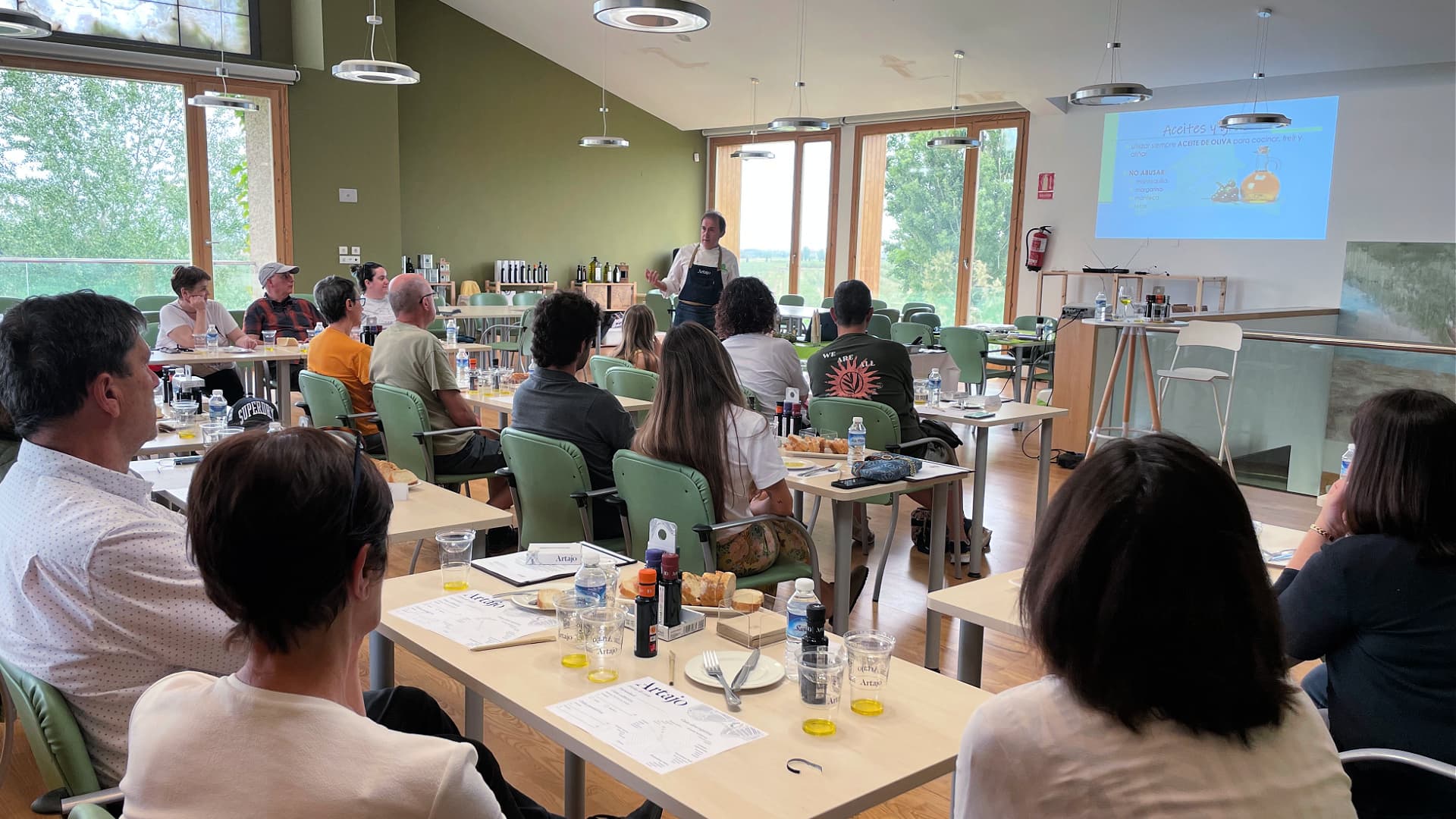
Offering guided olive oil tastings is among the various tourist activities offered by Aceite Artajo to help improve consumer knowledge about olive oil. (Photo: Aceite Artajo)
With several olive oil tourism initiatives, the estate offers visitors opportunities to explore olive oil production, learn how to appreciate the taste of olive oil, and deepen their understanding of quality and polyphenols.
According to Urzaiz, consumer education is essential for the growth of the olive oil sector.
“Right now, there’s still a lot of outreach work to be done,” she said. “Spain consumes a lot of olive oil, but many people still don’t know what extra virgin means.”
At Los Llanos, visitors can book guided tours, tastings, express visits or picnics among the olive trees. Motorhome travelers can stay overnight.
“We’re on a long road and part of oleotourism is raising consumer awareness about our ‘treasure,’” Urzaiz concluded.