Museum of Istrian Olive Oil Opens in Pula, Croatia
A museum dedicated to the history and development of olive oil in the Croatian region of Istria opened recently in the city of Pula.
Located in the center of Pula just a short walk away from a first-century Roman amphitheater, its official Latin name, Museum Olei Histriae, translates as the Museum of Istrian olive oil.
The museum is a labor of love and the brainchild of Pula-native Lorena Boljunčić, an art historian, marketing specialist, and entrepreneur who’s active in the local tourism industry. She fell under the spell of olive oil seven years ago when she took her family’s olive crop to the local mill and tasted the freshly-pressed oil fresh straight from the press.
This experience was the catalyst for the museum, an endeavor that has been solely financed through the private means of her company, Idea Istria. It’s surprising that such an initiative that’s so relevant to the region’s local history and gastronomy hasn’t received material support from local or regional authorities.
“This is the only museum of its kind in Croatia,” Boljunčić told Olive Oil Times. “I was inspired by a visit to a whiskey museum in Edinburgh’s old city that told the story of whiskey by covering its history and production process followed by a tasting session. I thought this would be a good model to follow for the museum.”
Covering an area of 500 square meters (5382 square feet), the pleasant light-filled space housing the museum includes a shop, exhibition space, kids’ corner and tasting room.
The permanent exhibition covers the historical background to the 2000-year-old history of olive oil making in Istria, as well as insights into the local manufacturing of amphorae, the evolution of the olive oil production process from ancient to modern times, and even details about the taxes and duties imposed on local producers during the time of the Venetian Republic.
Visitors also learn about the scientific composition of olive oil as well as its health benefits, including the chemical and sensory properties that are evaluated to determine the quality of an olive oil. “When designing the exhibition I researched the history of olive making in Istria and got important inputs from experts from the Institute for Agriculture and Tourism in Poreč where they have a lab for analysis. I talked to their experts and they gave me details about the composition of olive oil and parameters like free fatty acids. I also contacted local museums to see if they had any objects related to olive oil,” added Boljunčić.
The information panels and graphics making up the exhibition are presented in Croatian, Italian, English, and German, and the exhibit is complemented by an audio guide available in 12 languages (Croatian, English, Spanish, Italian, Slovenian, French, German, Russian, Czech, Polish, Hungarian, and Dutch).
Also making up the exhibition are several visual aspects: objects like clay amphora and various paraphernalia used in olive oil making, a short film on Istria as an olive producing region, and a graphical installation set up in a small dark room designed to resemble an existing but now defunct local 19th-century oil mill. Inside, a short film shot in the mill in the 1980s is projected, showing the ancient oil pressing technique in which olives are ground with a millstone and then pressed using a wooden contraption.
Included in the price of the entry ticket is a basic olive oil tasting session during which several quality local oils are sampled as well as a supermarket oil for comparison. In charge of the tasting sessions is Lena Puhar O’Grady, an olive oil expert trained in sensory analysis. Complemented by an attractively designed PowerPoint presentation, she introduces visitors to the qualities to look for in a quality olive oil, while sharing interesting facts. “Istrian olive oil is very low in free fatty acids,” she revealed. “It’s less than 0.1 percent, lower than the standard set by the International Olive Council which is a minimum of 0.8.”
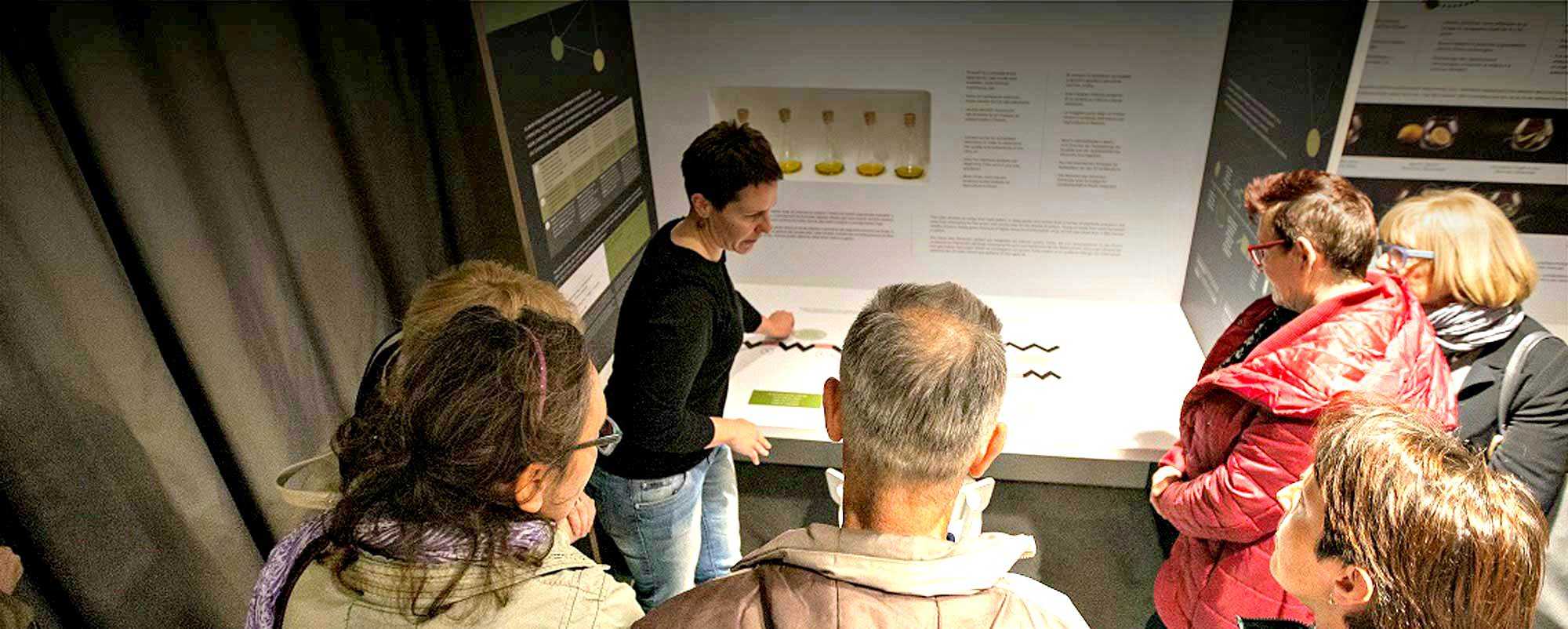
Following the basic tasting session, visitors who want to expand their knowledge and experience of Istrian olive oil can opt to taste five more local oils for a small extra cost. All of the tasting oils are available at the museum’s shop where there are a total of 25 high-quality olive oils by local producers on display, all international award winners.
For the museum’s founder, the educational aspect is particularly important and is designed to be accessible to all ages: the museum has already welcomed school groups from a local kindergarten and middle school. Boljunčić hopes that her initiative will serve not only as an important educational tool but will also encourage visitors to explore the world of olive oil further. “I would like the museum to be a kind of a point of first information that gives visitors an overview of the history of olive production in Istria and its development to the present day,” she explained. “They can also have the experience of tasting different olive oils by quality local producers. Then those who want to explore further can visit these producers, meet them and have a tour of their groves.”
As Croatia’s only olive oil museum, Museum Olei Histriae also promises to be an important tourist attraction showcasing Istria’s importance as an olive growing region. Since it opened its doors on May 9, 2017, the museum has already had many international visitors from Australia, New Zealand, Canada, the US, and several European countries.