Australian Olive Growers Have Good Harvest Despite Drought
Irrigation proved crucial in some areas of the country, but farmers and millers still experienced good volumes and a high-quality production.
Farmers and millers in Australia are reporting that the 2025 harvest concluded with satisfactory results in terms of yields and high quality.
“We had an ‘on-year,’ with some parts of the country very, very dry,” Michael Southan, the chief executive of the Australian Olive Association (AOA), told Olive Oil Times.
‘On-years’ and ‘off-years’ refer to the natural alternate-bearing cycle of the olive tree, in which fruit yields fluctuate between high and low.
See Also: Australian Growers on Alert After Xylella Fastidiosa Found in China“South Australia was in drought, one of the worst droughts they’ve experienced. Those who did not have access to irrigation in the region most of the time did not get a crop,” Southan said.
For the eastern states of the country, such as New South Wales (NSW) and Victoria, the season unfolded differently.
“There it was still dry, but to a lesser extent, and the yields were satisfying,” Southan said.
According to AOA figures, Australia produced approximately 13,200 metric tons of olive oil in 2024. This year’s harvest should easily exceed those volumes.
Cobram Estates, the largest olive oil producer in the country, reported processing more than 80,000 tons of olives and producing 14.2 million liters of olive oil.
As the previous season was an ‘off-year,’ this harvest and olive oil production performed significantly better.
“The turnout that producers are seeing is what we expected, not only in terms of volumes. The quality is excellent,” Southan said. “Of course, it is very early to say, as most of the olive oil is still being racked off and settled, so we haven’t seen too many new season olive oils just yet.”
“But from what I’ve heard, those who have been tasting the olive oils so far say they are of optimal quality,” he added.
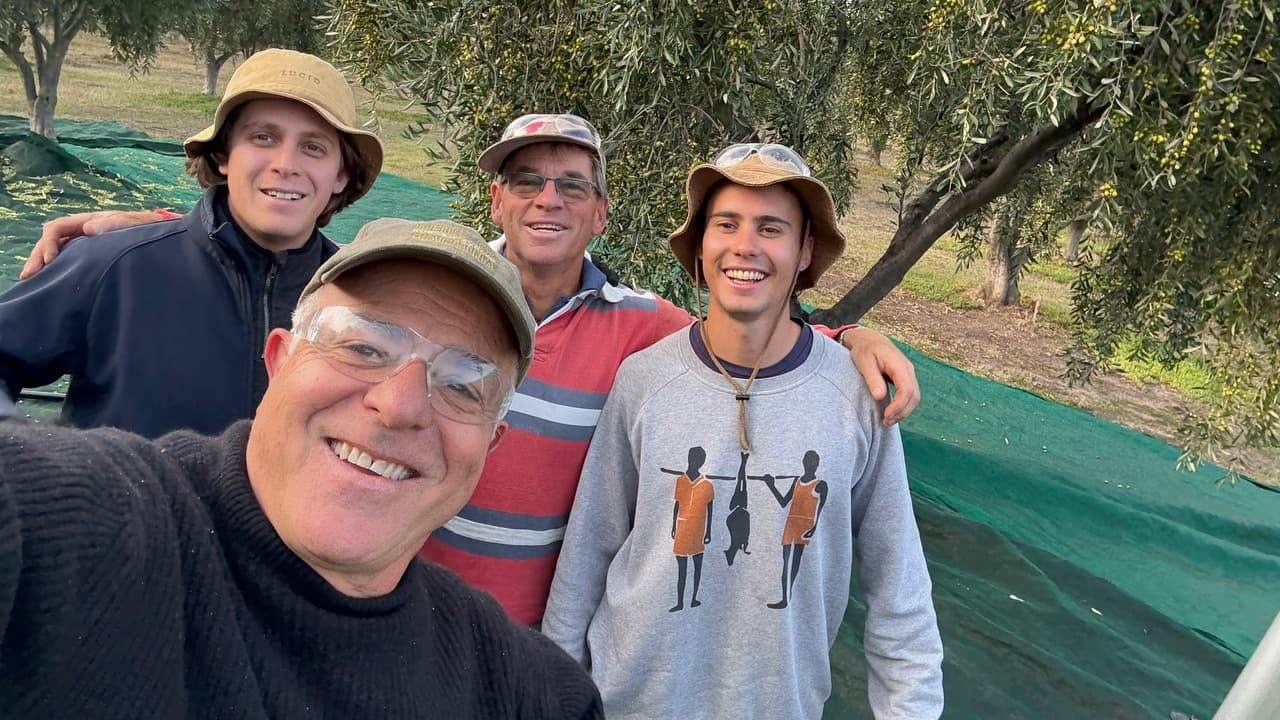
The team at Lauriston Grove expects a record-breaking year on Tasmania, both in terms of quantity and quality. (Photo: Lauriston Grove)
In Tasmania, high-quality producers are reporting their best results.
“The 2025 harvest was completed at the end of May, and it is a record-breaking harvest in terms of yield and volume of extra virgin olive oil,” said Marco Linardi, owner of Lauriston Grove.
“The quality is again very high, with some amazing extra virgin olive oil,” he added. “Our single-cultivar varieties are Frantoio, Manzanillo, Hardys Mammoth and Correggiola, all with unique flavors.”
Lauriston Grove was planted three decades ago in southern Tasmania. “The challenges we faced this season were minimal. We pruned heavily after last year’s harvest, so we were surprised by the incredible yield this season,” Linardi said.
In other areas, rainfall patterns remained manageable and helpful for olive growers.
“If we had some more rain, yields might have been higher, as we probably had larger yields in the past,” Southan said. “Still, more rain, particularly in summer, brings more issues with pests and diseases, which also cause problems with yields.”
While the last harvest paves the way for higher overall olive oil production, climate change and extreme weather events represent a growing challenge for many growers.
Peter and Caroline O’Cleary, owners of Homeleigh Grove, a small olive farm near Canberra, confirmed both the good season and the weather impacts.
“Olive oil quality was generally good, but milder than usual,” they said. “Yield was up on past years, ranging around a good 25 percent.”
“Our biggest challenge for the harvest was a severe hailstorm, which stripped a lot of fruit from the trees and bruised olives we intended to pick as table fruit,” the pair added.
According to the latest state of the climate report released by the Commonwealth Scientific and Industrial Research Organisation (CSIRO), the impacts include increasing heatwaves, longer fire seasons and more intense rainfall.
In this context, quality farming, irrigation and other adaptation measures become increasingly crucial.
According to AOA, the quality of olive farming is demonstrated in several ways, starting from pruning, which helped many growers achieve excellent results.
“Some of the trees, particularly those that have been well managed and pruned the year before, performed very well,” Southan said.
“Areas like the Hunter Valley probably had their best year in five years. And they had a wet summer and a wet autumn,” he added, referring to the NSW valley north of Sydney, which is also home to renowned vineyards.
“They even had too much rain, which caused a few issues with harvesters getting bogged or similar problems,” Southan continued.
According to AOA, the average level of Australian olive oil quality has been rising, with more farmers adopting advanced agricultural approaches and applying best practices.