Portuguese Group Expands Sustainability Program After Alentejo Success
Olivum seeks to add value to Portuguese extra virgin olive oils through an expanded certification program, ensuring environmental, social and economic sustainability.
An industry group responsible for 70 percent of Portuguese olive oil production is expanding its sustainability certification program after a successful trial in Alentejo.
“We spent two years developing it with a pilot group of producers and mills who helped us build this benchmark,” said Gonçalo Moreira, the coordinator of Olivum’s olive oil sustainability program. “What we saw was a success.”
“In the last year, we worked to turn it into a certification,” he added. “Now that we have finished and trained all the certifying bodies, they are in the field carrying out the first audits.”
When we talk about sustainability, there are three areas. We have to think about the environment. We have to think about the social aspect. And then the economic aspect.
Moreira expects the first bottles of Portuguese extra virgin olive oil to receive the sustainable certification seals as the 2025/26 harvest gets underway.
The idea for the sustainability certification emerged after Olivum explored the food industry for similar programs, drawing inspiration from sustainable winemaking initiatives in Australia, New Zealand, and California.
“But in olive oil, there was no benchmark for sustainable production,” Moreira said. “So Olivum took on the responsibility of trying to respond to market demands… and with this, to add value to the olive oil we produce here in Portugal.”
See Also: Rising Prices, New Technology Attract Private Equity Interest in Olive OilThe association’s sustainability team collaborated with local universities to identify 138 criteria, encompassing every aspect of production, from soil biodiversity and water use to packaging and transportation.
Moreira said these criteria are divided into four different levels, with the idea being that farmers and millers should take a methodical approach to implementing sustainable practices and building on them over time.
“We already have many good sustainability practices happening in the field,” he said. “We want to recognize these practices and communicate them — that is also what certification is for.”
“But we cannot stop there,” Moreira added. “That is why our benchmark has four levels. When a producer already has sustainable practices, we encourage them every year to do more until they reach the best practices.”
Certification audits are carried out annually by independent, government-recognized entities. The results of the surveys are published on a digital platform.
“We collect information about what is being done in the field and in each company,” Moreira said. “This gives us metrics and numbers. We cannot improve what we cannot measure.”
“With these measurements, we can see what is being done well and what is not evolving as we intended,” he added. “We need to work with producers, show new practices, and most importantly, communicate to consumers what is happening in the field.”
Producers cover the costs, but Moreira believes they will not be prohibitive.
Indeed, he stated that consumers have demonstrated a willingness to pay more for certified sustainable olive oil, with one study showing that they would pay €0.80 more per kilogram compared to olive oil without the seal.
“When we talk about sustainability, there are three areas. We have to think about the environment,” Moreira said. “We have to think about the social aspect. And then the economic aspect — if we do not have the economic side, the olive grove cannot function.”
“This is very important so that there can be social stability, so that growers and their workers are protected and motivated,” he added.
The launch of the certification comes six months after a report from Euronews, which described the rapid rise of super-high-density olive groves around the Alqueva dam in Alentejo as an “ecocide.”
Euro News reported that the dam has mainly benefited large investor-owned olive oil producers, including Elaia, De Prado and Aggraria, while failing to create enough well-paid jobs to reverse the rural exodus and damaging the environment.
“Scientists and environmentalists have warned that intensive olive farming in southern Portugal is transforming a once diverse landscape into monotonous rows of intensive plantations, damaging ecosystems and contaminating water and soil with agrochemicals,” Euronews wrote.
Pedro Horta, a policy officer at the Portuguese environmental organization Zero, told the pan-European broadcaster that the organization has documented the destruction of water networks, damage to protected areas, and agricultural practices that have resulted in soil erosion and degradation.
“Given the scale of the transformation of the landscape, we can call this an ecocide,” said Horta, further contending that super-high-density groves have also led to significant biodiversity loss.
Moreira disputed some of the reporting as misinformation and believes that independent audits of traditional, medium-density, high-density and super-high-density olive groves across the country will demonstrate the efforts made to improve sustainability.
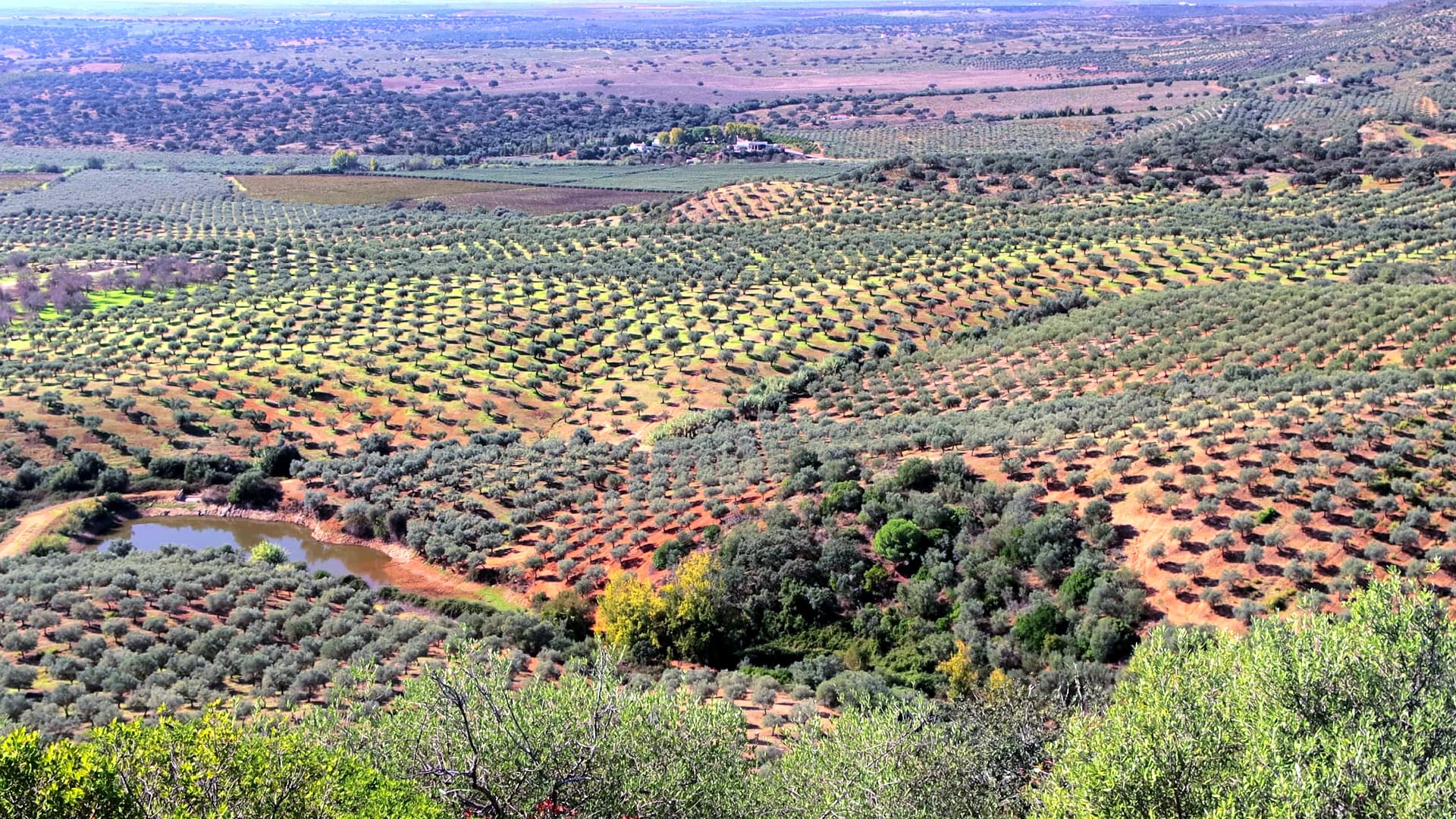
The rapid transformation of Alentejo’s landscape over the past two decades has led to skepticism about the benefit of the high concentration of olive groves. (Photo: Olivum)
“What we want is for the olive grove to contribute to leaving the environment and the areas where it is located better than before, to increase biodiversity, improve the soil and manage water properly,” he said.
Moreira said that producers participating in the program, from all kinds of olive groves, were planting vegetative cover to help capture natural rainwater, prevent erosion, sequester more carbon dioxide, and create habitats for native insect and bird species.
“This vegetative cover protects the soil, keeps more moisture, allows more carbon in the soil, and brings more biodiversity,” he said. “With this, for example, we have more beneficial insects, which means fewer treatments and less use of pesticides.”
According to Moreira, Portugal’s olive sector once accounted for 15 percent of the country’s total phytosanitary product use. That figure has now dropped to seven percent.
Other practices include adopting precision and drip irrigation systems powered by renewable energy, which enable farmers to automate irrigation when the plants need water the most, and leaving vegetation along irrigation lines to serve as biodiversity corridors.
Moreira stated that studies commissioned by Olivum have revealed a significant increase in biodiversity in modern olive groves, following the adoption of sustainable practices, including the presence of wild boar, tortoises, rabbits, and the Iberian lynx.
Moreira understands that there may be skepticism toward the planting of super-high-density groves around the Alqueva dam, which has transformed the landscape over the past two decades.
However, he expects that producers with the new sustainable certification can help communicate to consumers and the general public the benefits that can come with these groves.
“These groves did not exist 20 years ago,” he concluded. “What we are creating has changed the landscape, and people did not understand because it happened so quickly. But now there is less negative communication.”