Award-Winning Producer Credits His Team of ‘Harvest Experts’
For two months a team of 150 people harvest the olives at Cortijo Virgen de los Milagros, like their parents and grandparents did. “The mill is only the extractor,” says Luis Montabes. “Quality is born in the fields.”
At 8:30 am, the Cortijo Virgen de los Milagros brims with activity.
It’s chilly out there and crews of olive pickers gather at the doors of this typical Andalusian farm — the sticks to shake the trees at hand, water supplies and packed lunch ready to help them endure a long working day.
We are lucky to count on people whose great-grandparents came to this estate before my parents bought it in the early 70s. They are experts in harvesting olives.
They wait for the Range Rovers to take them to the tajo, as they call their working site in the fields. From 9 am to 4:30 they will be picking olives at the olive grove, with a break of 30-40 mins.
See Also: The Best Olive Oils of 2017
This estate of almost 600 hectares (1,483 acres) belonging to the Montabes Vaño family lies at the heart of Jaén’s famed Sea of Olives.
Over 3.5 million kilos of olives are picked here every year and an average of 800,000 liters of oil are produced in the estate’s mill.
All of Monva’s olive oil, including its award-winning Dominus Early Harvest– comes from the Cortijo Virgen de los Milagros.
Mancha Real is the closest village, just 5 kilometers away, and Sierra Mágina — the mountain range that gives the name to this protected designation of origin area, overlooks the seemingly infinite olive grove.
This is Picual territory, Jaén’s favorite cultivar, and harvest season is peak time here.
More than 150 people work at the estate during this period, up from an average of 50 to 60 employees the rest of the year.
In addition to eight picking crews (cuadrillasin Spanish) of 10-15 members, there are dozens of tractor and vibrator drivers and the staff of the mill. The logistics of the harvest and milling of such a big estate is not an easy task.
Whereas olive harvest in Andalucía spans more or less from November to January, at Monva, this period shrinks to just over two months, starting at the end of October. Luis Montabes, Monva’s sales manager and one of the owners of this family-run company, shared the reason for this difference.
“We produce three different kinds of olive oil. For the early harvest one, we use green olives before they ripen. For the extra virgin olive oil we use olives that are just starting to ripen and then we make extra virgin oil with ripened olives,” he said.
“That is why we move harvesting forward a lot compared to the cooperatives in the area and in Andalucía. This makes it so by the end of the harvest the fruits remain in the trees, so we don’t have to pick them from the ground. Once fruits have fallen to the ground there is no quality at all,” he told Olive Oil Times.
In the fields, activity is frenetic. Those in charge of beating the olive trees with sticks (varear in Spanish) are mostly men. Then, workers groom the canvases where olives fall in order to remove branches and leaves. Others pull the canvases and move them from one tree to another.
“Each tree demands a different way of harvesting. Here we use inverted umbrellas where olives are shaken and fall directly on the umbrella. We also do ‘milking’ harvest for younger trees. And we use canvases and big size vibrators for bigger olive trees,” Montabes told us.
Picking olives is a fast and intense job as quality depends partly on how quickly harvested olives are collected in tractor trailers and brought to the mill. At Monva, the whole process takes less than 3-4 hours.
Felipe Castro is the one responsible for arranging the harvesting operation: he decides where to start picking olives and distributes the crews along the fields.
To keep record of all that he just needs a pad where he writes down some notes. No computers, apps or drones. He has spent more than 48 years of his life at the estate and knows it by heart.
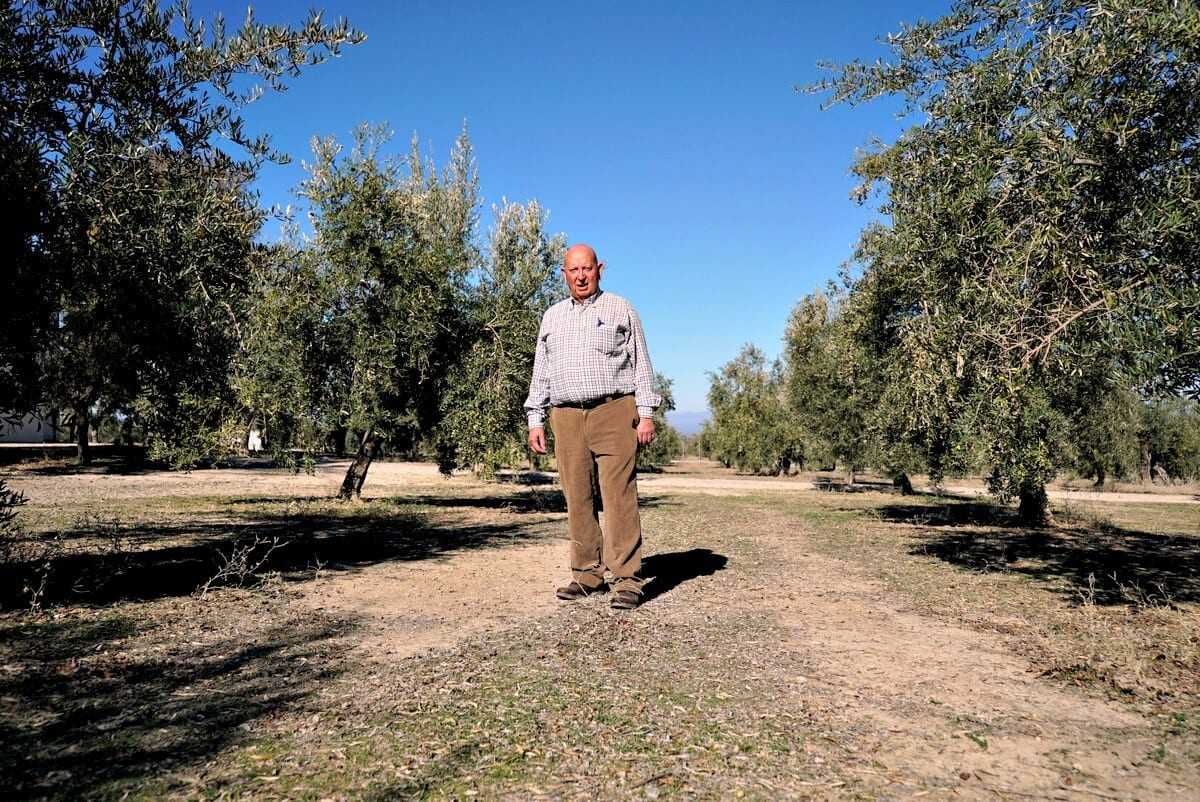
Felipe Castro
“My work is organizing the harvest and supervising the mill and the bottling process. Being a family company, we are at every site,” Castro said.
“I have two assistants who help me. We constantly go up and down the fields before the harvest to check where the olives are more ripened. Or when we have to pick the green ones for the early harvest oil, we choose the ones that we like the most. After so many years you know the plots like your own sons. You don’t need much to know how they are,” he explained with a deep Andalusian accent.
Most of the olive pickers at the Cortijo Virgen de los Milagros come from Jaén and Granada and some of them live at the Cortijo during the harvest. Others prefer to stay in villages nearby.
Cortijos — traditional Andalusian country houses — have traditionally provided workers with accommodations. In the past, when harvesting lasted longer, Virgen de los Milagros used to turn into a small village and even had a small school and shops for the olive pickers’ families.
“We are lucky to count on people whose great-grandparents came to this estate before my parents bought it in the early 70s. They are experts in harvesting olives,” said Montabes.
“Their role is key as it consists not only in harvesting properly this year’s olives but in taking care of the tree for next year. Because if you shake it the wrong way you may harm next year’s sprouts.”