Early Harvests, Ethics and the Pursuit of Exceptional Olive Oil
Slovenian miller and olive grower Sandi Babič explains why early harvests, ethics and personal responsibility are the foundation of world-class olive oil.
In Slovenia, the small European country between Croatia and Italy, nearly everyone knows Luka Dončić. Many also know Sandi Babič, a leading Slovenian olive grower and owner of a cold-press mill located on the outskirts of Koper, the largest city on the Slovenian coast.
Babič is often described as a pioneer of excellence in Slovenian olive oil. He prefers a different definition.
“The real pioneers are the people I learned from,” he said, pointing to researchers at Slovenia’s Institute for Olive Growing. “I see myself as an advocate for excellence, someone who tries to lead by example and encourage Slovenian olive growers to internalize modern global trends in olive farming and olive oil production.”
According to Babič, clear ethical standards and shared rules of conduct are essential if Slovenian olive oil is to gain wider international recognition.
Excellence Begins With Responsibility
Asked how excellence is achieved, Babič pointed to Italy’s long-running promotion of the Mediterranean diet, a campaign that reshaped agriculture, food culture, tourism and manufacturing.
“Extra virgin olive oil was the cornerstone of that success,” he said. “It became a global symbol of health, quality and lifestyle.”
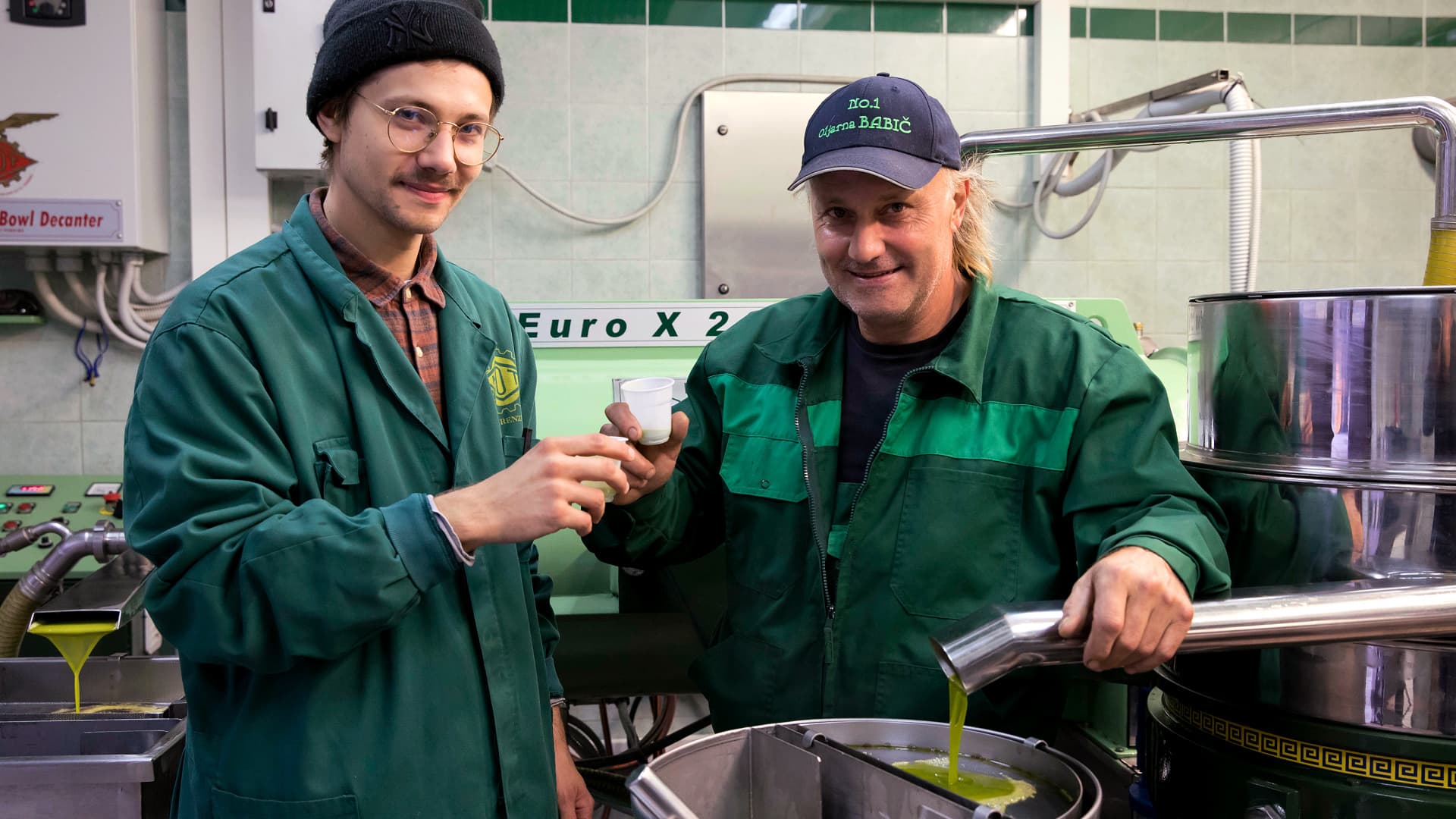
Son Rok and father Sandi, dedicated to the production of premium oils
Slovenia and Croatia, he added, have no natural disadvantage.
“Our geography, soils and climate give us the potential to produce oils equal to — or better than — Italy’s,” Babič said. “Excellence is not created by laws. It comes from conscience, ethics and personal responsibility.”
A Calling, Not a Business
Babič began olive growing in 2009, a decision he describes as bold and intuitive rather than calculated.
“Olive growing isn’t a job — it’s a vocation,” he said. “The groves and the mill don’t belong to me. I belong to them.”
In 2015, he completed the production chain by opening Uljara Babič, equipping it with machinery from Officine Meccaniche Toscane and committing himself fully to producing what he calls “the best of the best.”
Why Early Harvest Matters
Babič is a strong proponent of early harvesting, even at the cost of lower yields.
“Yield is not a measure of quality,” he said. “If a grower focuses only on yield, the result is more oil, but oil without character.”
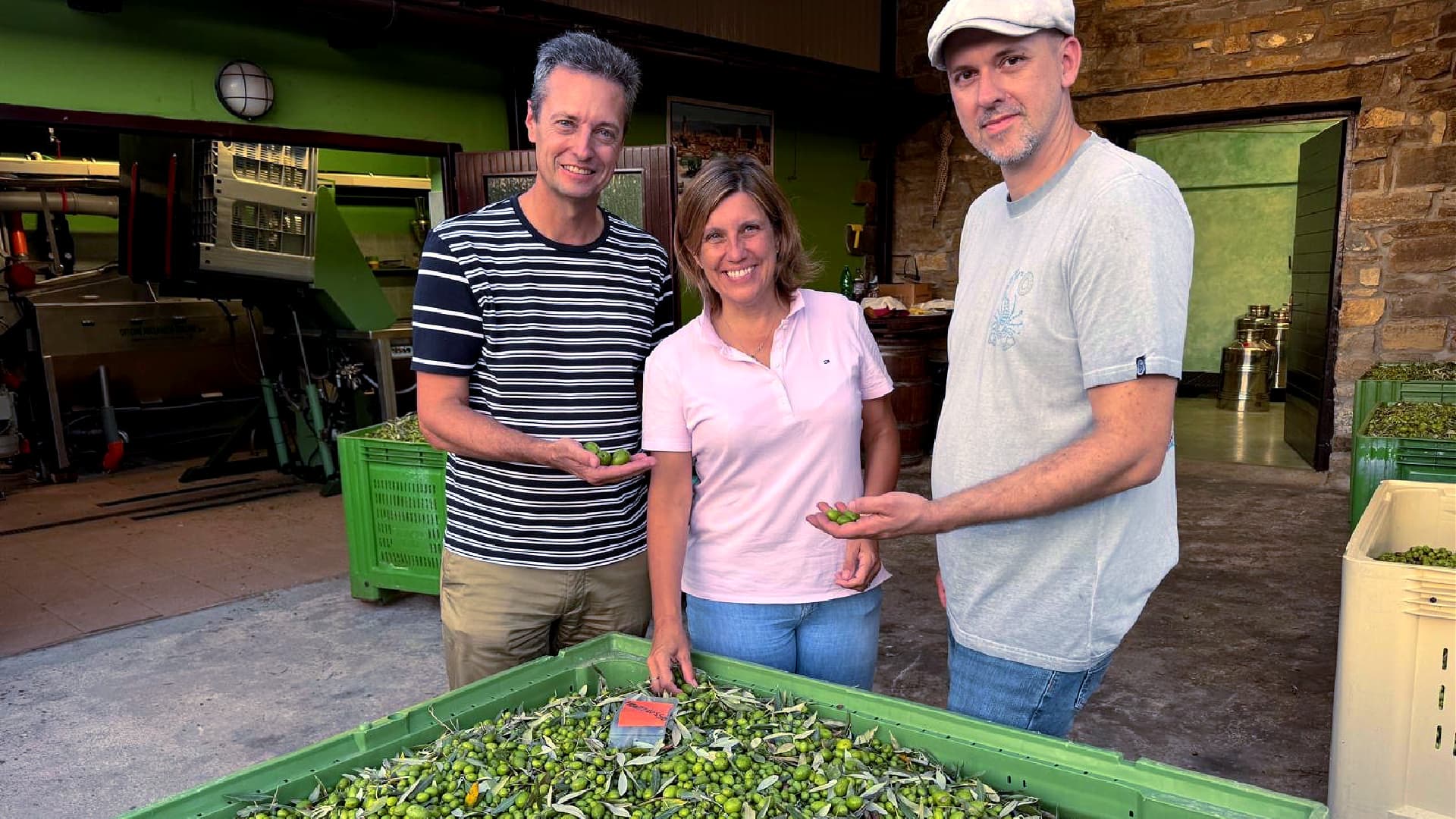
Davor Dubokovič, Maja Podgornik and Danijel Stojković Kukulin
Research shows that oils from early harvests contain higher levels of polyphenols, along with brighter color and more pronounced bitterness and pungency. However, Babič warned against rigid calendar-based harvesting.
“Early harvest does not mean unripe olives,” he said. “It means harvesting at the optimal moment for the variety, location and season.”
Varieties, Creativity and Balance
Babič’s groves include native Istrian varieties such as Belica, Buža and Rošinjola, alongside Leccino, Frantoio and Coratina.
“There is no room for rigidity,” he said. “Every grower should value local varieties but also remain open to experimentation. Creativity is essential in producing great olive oil.”
Cold Pressing Is Not Enough
Babič is skeptical of oversimplified rules, such as focusing solely on extraction temperatures.
“If olives arrive overripe, damaged or already warm, temperature control becomes irrelevant,” he said. “From poor fruit, you cannot make great oil.”
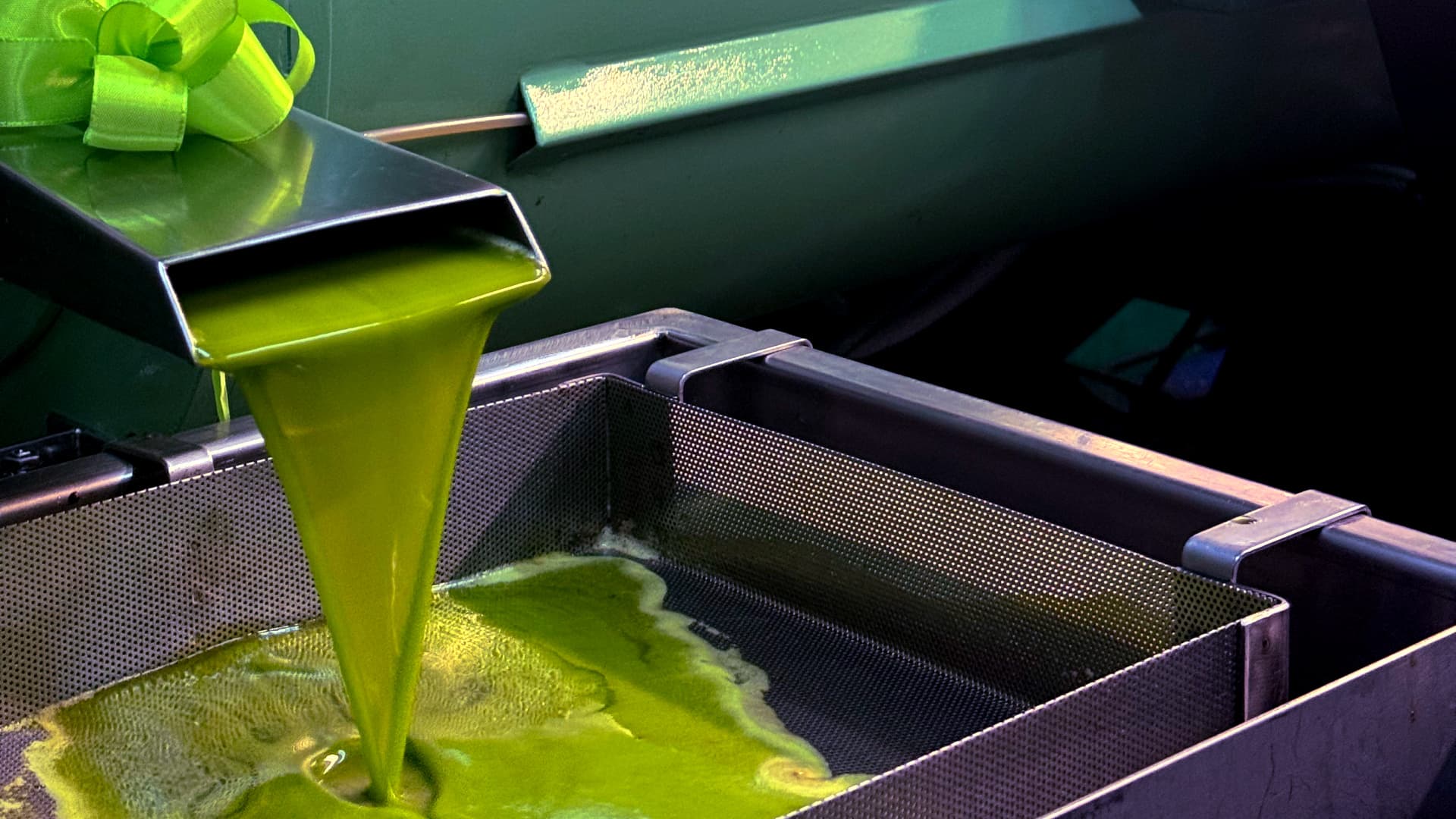
Early harvest oils have more polyphenols.
Quality, he emphasized, begins in the grove and depends on a structured process that includes cultivation, harvest, milling and storage.
Craft, Science and Trust
Babič believes the best results come from combining formal scientific knowledge with experience and intuition.
“Pure science without instinct is incomplete,” he said. “A skilled miller who truly understands the machinery can shape bitterness, pungency and fruitiness while preserving nutritional value.”
That approach has earned Uljara Babič the trust of growers from Slovenia, Croatia and Italy, many of whom travel long distances to mill their olives there.
Prices, Fraud and the Gray Market
Responding to criticism that Slovenian and Croatian oils are expensive, Babič argued that the price must be viewed in context.
“A bottle of wine is consumed in a meal, while a liter of olive oil lasts a household a month,” he said. “Quality takes years, not weeks.”
He warned that unregulated gray-market sales distort prices and undermine consumer trust, calling for systematic monitoring to address olive oil fraud.
Sustainability Beyond Marketing
Babič expressed skepticism toward superficial notions of “olive oil culture,” arguing that true sustainability lies in preserving landscapes and local communities.
He pointed to the planting of millions of olive trees in Istria as an example of how olive farming can protect ecosystems, biodiversity and quality of life.
A Challenging Future
Looking ahead, Babič warned that olive groves across the Mediterranean may increasingly compete with solar farms for land, particularly in regions such as Puglia.
“In the name of global sustainability, we risk destroying the sustainability of local life,” he said.
He expects olive production to expand further in North Africa and the Southern Hemisphere, while Slovenian producers will need to adapt cultivation and processing methods to climate change.
“The future depends on our willingness to change,” Babič concluded, “without abandoning quality.”