Historic Hadrian Olive Oil Returns
In keeping with Hadrian’s love for knowledge and the intellect, the olive oil will be sold in his Villa’s bookshop.
Olive oil from Hadrian’s orchard is flowing again. The Roman Emperor’s second-century retreat, Hadrian’s Villa, has produced 78 bottles for the initial sale of this comeback product.
The 100-acre park and villa are in Tivoli, 20 miles east of Rome. The 3,500 olive trees in the park are all more than 200 years old.
A show where you can cater to a highly knowledgeable consumer.
Hadrian’s Villa curator and historian Andrea Bruciati plans to market produce from Villa d’Este, the adjoining park built by Cardinal Ippolito II d’Este. He hopes to grow Pizzutellos there, an unusual oblong grape famed for its sweetness.
Cardinal d’Este brought the grape from France and the region’s annual Pizzutello festival, which dates back to 1845, features a costume parade and celebration of this heirloom grape.
Bruciati is committed to the slow food movement, and he thinks the Villa Adriana and the Villa d’Este are the perfect place to raise awareness of old agricultural ways. Six hundred thousand visitors visit annually to enjoy the grounds.
“Safeguarding the artistic and cultural heritage means not just protecting the landscape but also the pastoral agriculture that in some way is its soul. Supporting the local oil with a gesture like ours means adhering to the spirit of the place,” the Telegraph reported Bruciati saying. “The olive groves can’t be a mere background to the Villa because they are an integral part of its perception, in the collective image of millions of people.”
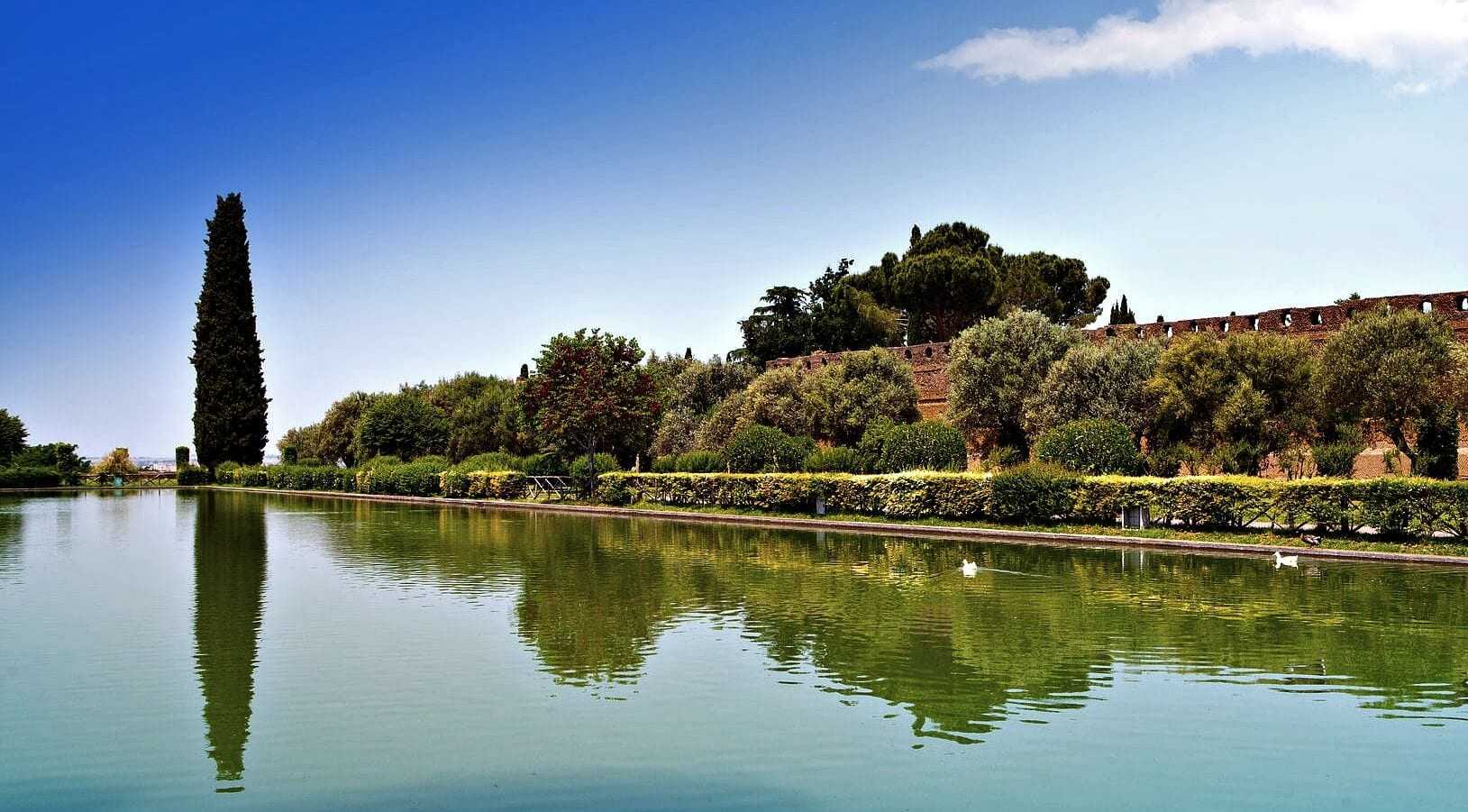
Villa Adriana, Tivoli
As a UNESCO site, Hadrian’s villa is devoted to safeguarding intangible culture. Part of the UNESCO definition of intangible culture includes “knowledge and practices concerning nature and the universe,” which fits the goal of preserving and harvesting these revered olive trees.
Hadrian was emperor from 117 to 138 AD. A rare bearded ruler (he took his fashion cues from Greek philosophers), his villa provided a government retreat outside Rome.
He was an amateur architect and his huge property gave him space to construct libraries, temples, baths, sculpture gardens, ponds, fountains and dining halls. In keeping with Hadrian’s love for knowledge and the intellect, the olive oil will be sold in the villa’s bookshop.
Bernard Frischer, founder of the UCLA Cultural Virtual Reality Laboratory, is a pioneer in 3D computer modeling of cultural heritage sites. His creation of a 3D restoration model of Hadrian’s Villa is one of several projects he’s done of important sites in Italy.
“I am sure that Hadrian would have been delighted to know that his Tiburtine villa (note that he had many others) remains so well intact, that it attracts tens of thousands of visitors each year and that through the villa, his memory is kept alive so many centuries after his death,” Frischer told Olive Oil Times.
“Certainly the cultivation of olive trees and production of olive oil would have been an important part of what the Tiburtine villa produced. From the oil made in the immediate vicinity of the villa today, it is clear that the soil and climate conditions were very favorable for producing flavorful and abundant olive oil there.”