Extreme Olive Growing in Valle d’Aosta and Piemonte
Growing olives in Valle d’Aosta, a mountainous region enclosed by the Alps, seemed unthinkable until a group of daring farmers decided to try.
“Our adventure started about twenty years ago,” said one of the first olive growers in Valle d’Aosta. “I had a small house on a hill in the territory of Donnas, surrounded by lands previously taken up by vineyards, which were suffering increasing abandonment,” Dario Martinelli pointed out. “The bush started to overgrow the terraces, and at some point, with the idea of an olive grove which would have helped to recover the lot, I thought to myself: Let’s try.”
For the first harvests we had to wear warm clothes, and the last ones we carried out in t-shirts.
Valle d’Aosta is a mountainous region — the smallest of Italy — enclosed by the Alps, with climate and soil conditions ideal for growing grapes. Due to its continental climate, the possibility to grow crops like olives seemed unthinkable until a group of daring farmers decided to try.
It was 1999 when our farmer planted a small olive grove. “Trying to figure out which were the best varieties for this weather and soil conditions, I started with fifteen plants of Leccino because it should give good results even with a harsh climate,” he considered. “And, in fact, those proved to be resistant to the cold and frost of the early years.”
The initial harvests were not easy, as olives often need to be picked in the snow. Despite that, Martinelli continued to add more land and olive trees, including several plants of Frantoio “with a purpose which was just based on my stubbornness and persuasion.”
Those first olive trees are located at 350 meters (383 yards) above sea level, on a steep slope which was recovered by the farmer’s great-grandparents after a landslide occurred. They recreated paths and walls, and many years later, he continued to build walls and fill the terraces while clearing out the bushes and spreading manure to enrich the soil.
“At the time, my work seemed unnecessary and fruitless, but I was driven by the desire to manage that olive grove and see that land flourishing again,” he said, pointing out that he now manages 180 healthy olive trees scattered on a plot of almost 5,000 square meters (around 1 1/4 acres).
Martinelli found other farmers interested in olive growing. At the beginning, there were only a few who believed in it, but gradually the potential of the new activity gained traction. The first group of producers created the Piemonte Olive Growers Association, which currently has more than 350 members from areas including the Canavese and Aostan Dora Baltea valleys; the Ivrea Morainic Amphitheater and the Monferrato Casalese and the Monviso valleys.
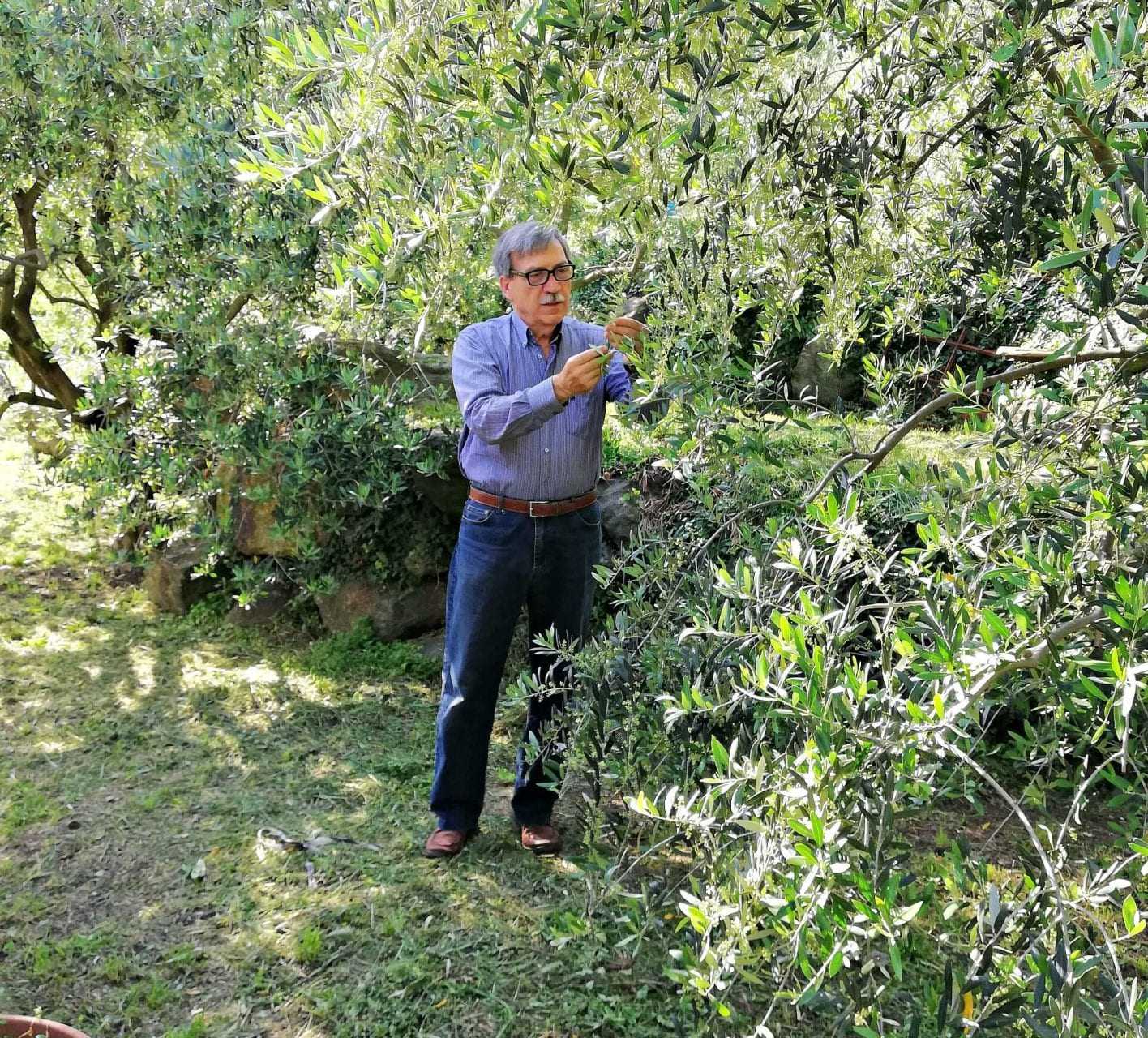
Dario Martinelli
Now, in Valle d’Aosta, there are more than 3,000 olive trees whose fruits are crushed into the mills of Settimo Vittone and Vialfrè, in Piemonte, near the border.
“For the first harvests we had to wear warm clothes, and the last ones we carried out in t-shirts,” Martinelli observed, revealing that he was further motivated to pursue his objective by the increasingly frequent good weather.
The experience of these farmers illustrates what science has confirmed: The temperature in the Alps has increased by 2°C since the end of the 1800s, about twice the average increase of the Northern Hemisphere.
“Some farmers started planting sporadic olive trees since the late 1990s because at that time we had the perception of particularly hot and dry summer seasons,” said Antonino De Maria, an expert in olive growing who participated in several research projects.
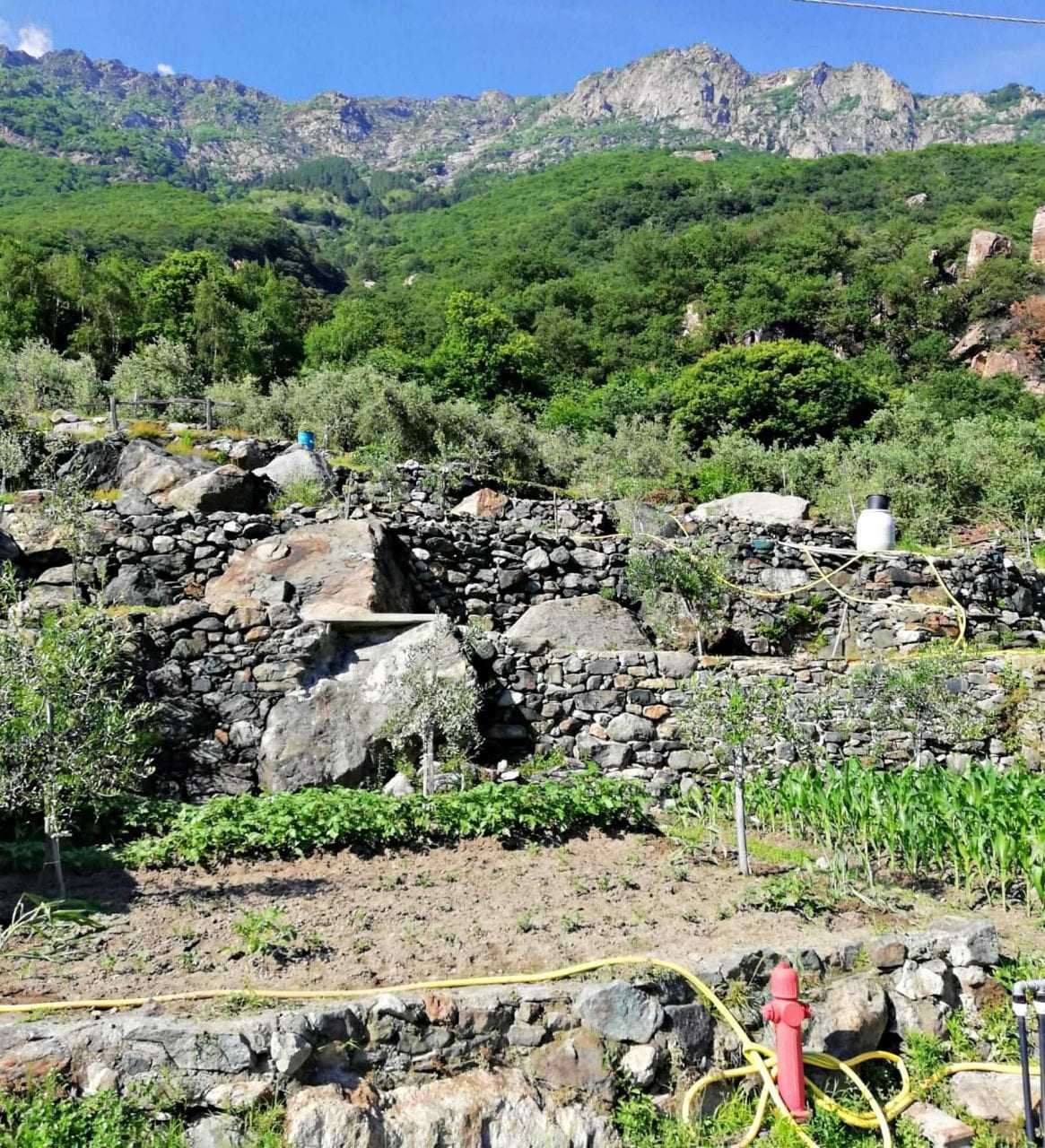
Dario Martinelli’s terraced olive grove under the mountains
“Between Piemonte and Valle d’Aosta there are currently around 250,000 olive trees, most of which have been planted since the 2003-2004 season,” he observed, specifying that, in 2005, 2006, 2007 and 2011, drops in temperature created problems and in the 2011-2012 season many olive trees were lost. Various projects were carried out by the Department of Agriculture of the University of Turin to understand which varieties are best suited to the climates of Piemonte and Valle d’Aosta.
“We saw that, in addition to Leccino and Frantoio, which can be vigorous and productive in this environment, pollinators like Moraiolo and Pendolino are suited to these climatic conditions,” he noted.
“Also, Leccio del Corno, Brisighella, Borgiona, Grignàn and varieties from northeast Italy and Croatia such as Bianchera and Drobnica, and the Carolea, widespread in south of our peninsula, can be cultivated well and with a good yield.”
Although the total production is still limited, the last harvests in Valle d’Aosta and Piemonte gave very good results in terms of volumes and quality, thanks to ideal weather conditions.
“We tasted great extra virgin olive oils, with interesting fragrances, which are being sold by the growers at attractive prices,” De Maria revealed, adding that since 2007, the Consortium for the Protection of Piemonte and Valle d’Aosta extra virgin olive oil has worked to enhance the production of the two regions which is still young but very promising.