Farmers in Hungary Make Headway in Olive Cultivation
Capitalizing on the country’s warming winter weather and the persistence of farmers, olive trees flourish in Hungary’s southern territories around Lake Balaton.
As Europe gets warmer, olive trees have begun to take root in unlikely regions away from their traditional growing areas around the Mediterranean.
In the central European country of Hungary, olive trees have found a fertile home on the southern slopes surrounding Lake Balaton, one of the country’s major wine-producing regions and a popular tourist destination.
I managed to harvest my highest yield this year, 232 kilograms, the highest in Hungary. As my younger trees continue to grow, I believe doubling the yield is realistic.
“The area features a unique microclimate and is incredibly picturesque,” 55-year-old local winemaker and olive oil producer Csaba Török told Olive Oil Times.
“It is surrounded by the Witness Hills that emerged from the remains of the ancient Pannonian Sea, and the soil here is rich in volcanic material,” he added.
See Also: Olive Oil Production Becomes Increasingly Viable in OmanTörök noted that, as southern Europe becomes warmer and drier, areas suitable for olive cultivation are shifting northwards.
According to the European Environment Agency, Europe is the fastest-warming continent. Extreme weather events, such as heatwaves and droughts, are expected to worsen.
Over the last two decades, southern Hungary has also experienced milder winters and warmer summers. Scientific research has also found that Lake Balaton’s surface water temperature has risen by almost 2 ºC since 2000.
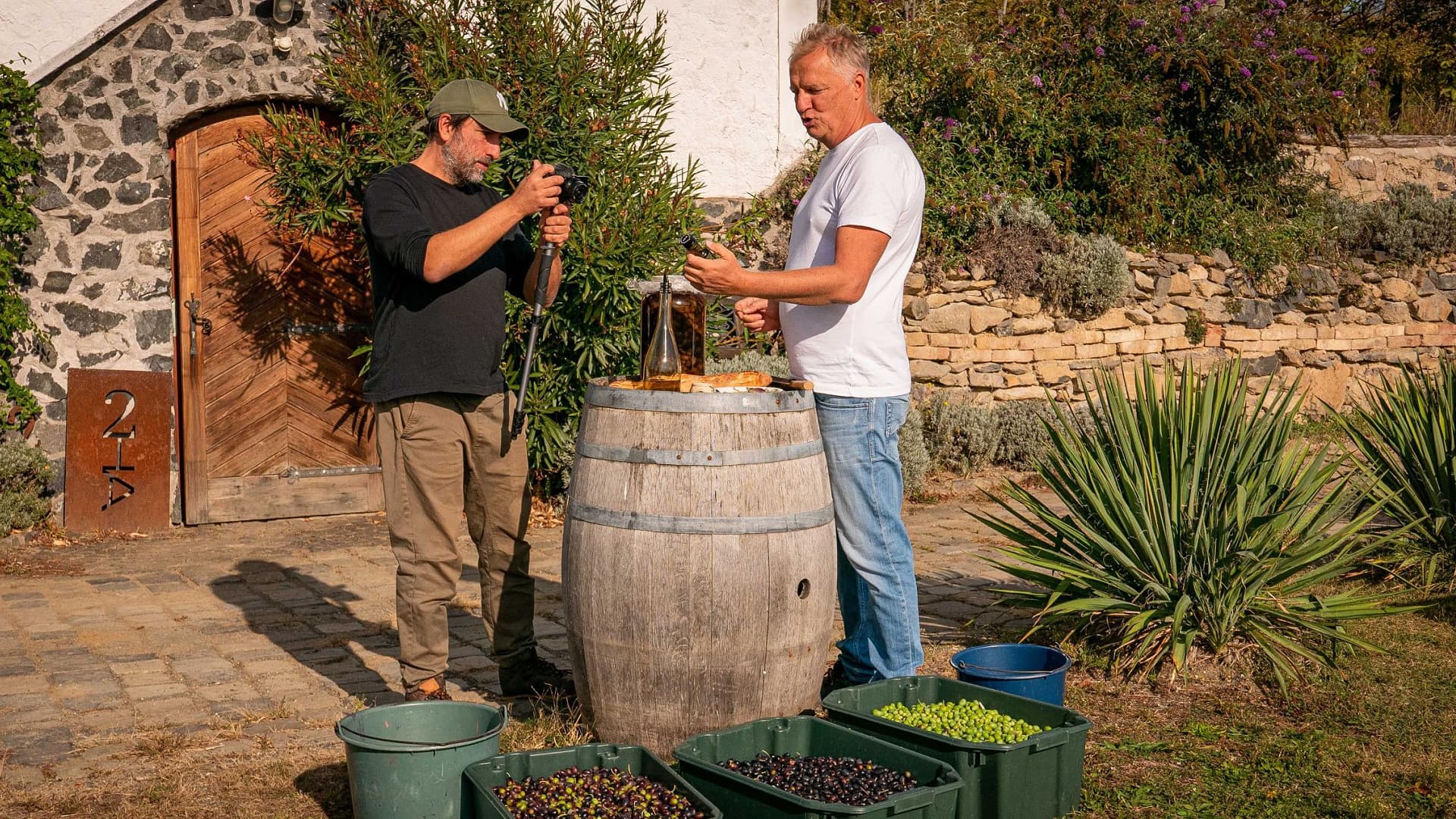
Török started to grow olive trees with his Sangiovese grapes to prove his doubters wrong. (Photo: Csaba Török)
Török established his vineyard and winery in Szent Gyorgy Hill around 20 years ago. A few years later, he planted his first three olive trees next to his vines to prove that olive cultivation was feasible in the area.
“When I arrived here, I planted red grape varieties, particularly Sangiovese,” Török said.
“At the time, this area was considered suitable primarily for white grape varieties, and many people told me that these vines would never survive in this climate.”
“But I proved them wrong,” he added. “To further demonstrate that I had made the right choice, I also planted some olive trees since Sangiovese is often cultivated alongside olives.”
Finding the most suitable olive varieties to plant has been a journey for Török, who eventually succeeded in olive cultivation by trial and error.
“In my first attempt, 200 young Leccino trees, then 15 years old, froze during the winter – a costly lesson,” he said. “But I started again, and the current state of my plantation has taken shape over the past eight to ten years. I made more informed decisions and learned a great deal about these trees along the way.”
Török’s vineyard and olive grove stretch across six hectares and comprises over 60 olive trees of various olive varieties, including the Spanish Picual and Arbequina, the French Aglandu and Mouflal and Leccino from Italy.
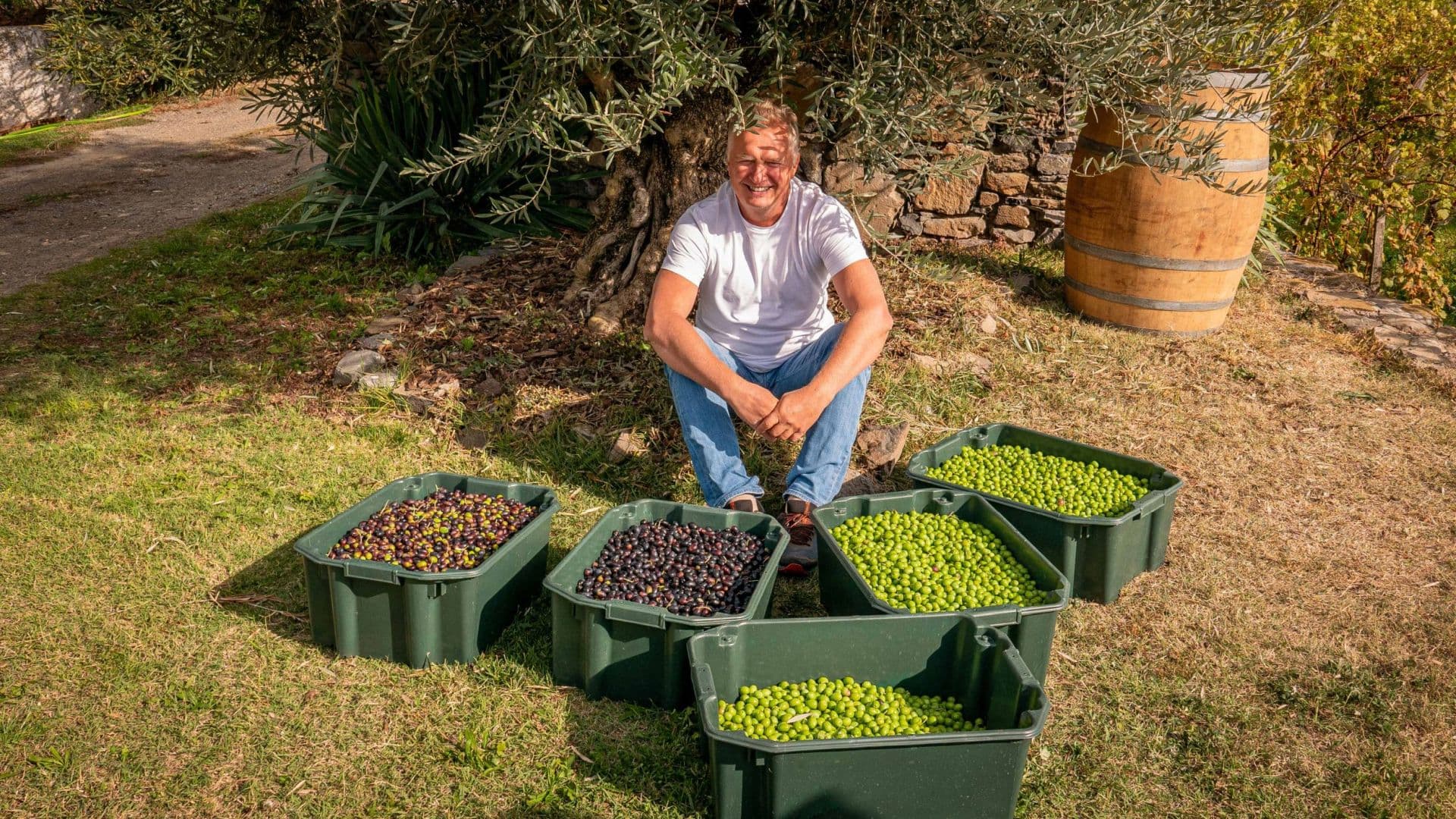
Csaba Török with his harvested olives (Photo: Török)
The grove also contains three olive cultivars native to the Balkans: Oblica and Bjelica from Croatia and Carolea from Slovenia. Around a dozen of the olive trees Török that grows are between 50 and 400 years old, while the rest are 10 years old.
In 2020, Török became the first in Hungary to produce olive oil from locally harvested olives. This crop year, he achieved his most abundant yield.
“I managed to harvest my highest yield this year, 232 kilograms, the highest in Hungary,” he said. “As my younger trees continue to grow, I believe doubling the yield is realistic.”
Although the weather is becoming milder in the area, winter temperatures often drop below freezing, posing a significant challenge for Török.
“The biggest problem is the winter cold,” he said. “At my estate, the lowest temperature recorded in the past 15 years was –14.7 ºC, and even then, it lasted only for an hour. Typically, it doesn’t drop below – 10 ºC.”
“I believe the best sites for grape growing – those with the ideal angle, orientation, elevation, and other factors – are also the most suitable for growing olives, providing consistent fruit production year after year,” he added.
Depending on the variety, olive trees can tolerate temperatures as low as – 12 ºC. However, prolonged exposure to freezing temperatures below –7 ºC can seriously damage them.
Török also noted that in the last three years, many farmers near Lake Balaton have started to grow olive trees, albeit some of them only for decorative purposes.
“It feels like I was the one who switched on the green light,” he said. “However, many of those who grow olive trees lack professional knowledge. They plant olives simply because they love them, not because they want to make a living from them.”
Olive farming has expanded to more regions in southern Hungary. Southeast of Lake Balaton, near Pécs, gardener and farmer Gabor Stix has been growing olive trees for nearly two decades.
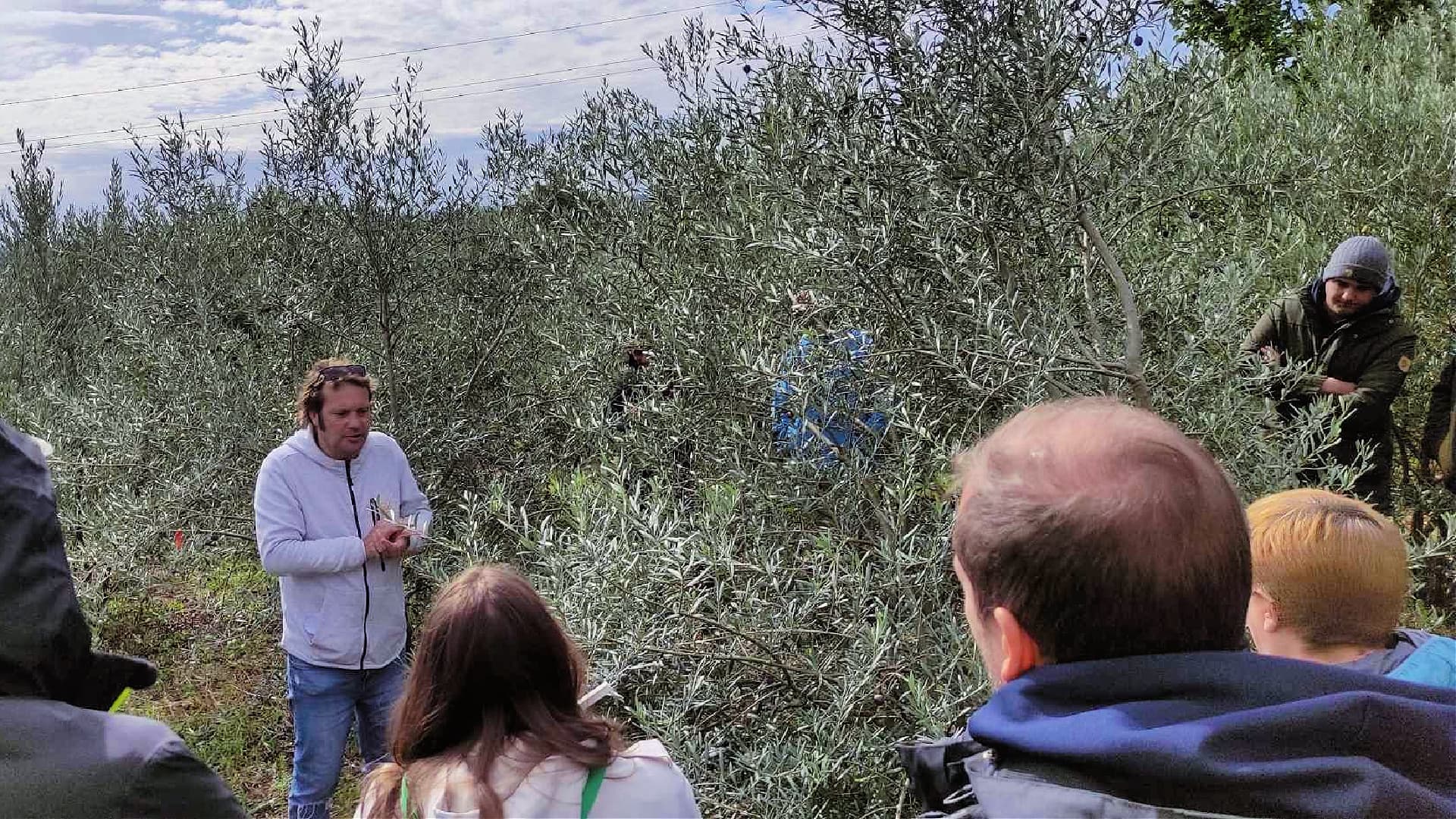
Gabor Stix with visitors in his olive grove (Photo: Gabor Stix via Facebook)
“[Olive trees] are one of the most grateful plants I have dealt with so far,” Stix told Hungarian online publication Zöld Hang. “We have clay soil, which suits them perfectly. Their water needs are not special either; we get as much water as they need.”
Stix’s olive trees are chiefly destined for selling, and he expects to sell all of his trees by March. He also produces small quantities of olive oil locally using a hammer mill to crush the olives and a wine press to extract the oil from the olive pulp.
Stix attributed the endurance of the olive trees he grows and sells to their local breeding and the adaptation of the young trees to local weather conditions.
“It works because we sell plants that we produce ourselves,” he said. “Acclimatization is important because the trees learn how cold it was the previous year and develop accordingly the following year.”
“So far, not much oil has been produced in Hungary, but the modest quantity is of a very good quality,” Stix added. “The price of one liter of olive oil produced in Hungary is around 45,000 to 50,000 forints [approximately €109 to €121]. It seems unbelievable, but people still buy it.”
“We already have larger plantations in our country,” he concluded. “I think it’s a great advantage here in Hungary that we have such opportunities.”