How a Practical Joke Led to Award-Winning Olive Oil
On a whim, two cousins from Zagreb started growing olives 15 years ago. Now, they are entering the NYIOOC once again and hoping for Gold.
A pair of unlikely olive growers have once again made the 300-kilometer journey from their homes in the Croatian capital to their groves in northern Dalmatia.
Mladen Koša, 53, and Mirko Mišura, 51, are cousins who spent most of their lives in Zagreb before a practical joke from Mišura’s father led the pair down the path to becoming award-winning olive oil producers.
To win an award at such a prestigious world competition (such as the NYIOOC) is every olive grower’s dream.
“I can’t wait to get there. First to the olive grove, and then to the cottage,” said Mladen Koša, who grew up in Zagreb and works at the Zagreb Fair, the country’s leading venue for trade shows and exhibitions.
“It all started as a joke,” said Koša, explaining how he and Mišura, who also lives and works in Zagreb, became olive farmers in the heart of Ravni Kotari, a large plain in central Croatia about 60 kilometers north of Zadar.
See Also: Producer Profiles“One evening, 15 years ago, my uncle and Mirko’s father, Milivoj Mišura, told us as a prank: ‘Guys, I have 8,000 square meters of land in Perušić. There you are and do what you want. Plant olives,'” he added.
Koša said that he did not wait long to answer. He and his cousin quickly got to business and planted 150 of the indigenous Oblica variety, 43 Krvavica trees and seven Leccino trees, which proved to be a good pollinator.
Hence, the Explanta Ko-Milfa family farm was born. Soon after, the cousins bought another 1,500 square meters of land, planting figs, almonds and 50 more olive trees.
They are currently arranging to purchase an additional 5,000 square meters of land next to the existing olive grove.
“We would buy more, we want to enlarge the property, but no one will sell, even though the land next to our olive grove is uncultivated,” Mišura said.
In the newly plowed and flattened soil, the cousins will plant a high-density olive grove with Oliana, Arbequina, Lecciana (a cross between Leccino and Arbequina), Coratina, Kvavica and Pendolino varieties, all of which better tolerate the region’s changing climatic conditions.

“We want to have enough oil every year. If the trees fail, domestic varieties will not be introduced,” the cousins said as they began pruning their trees.
“We are in no hurry to start pruning. In February, the budding begins. In March, you can see exactly which ones are native,” they added.
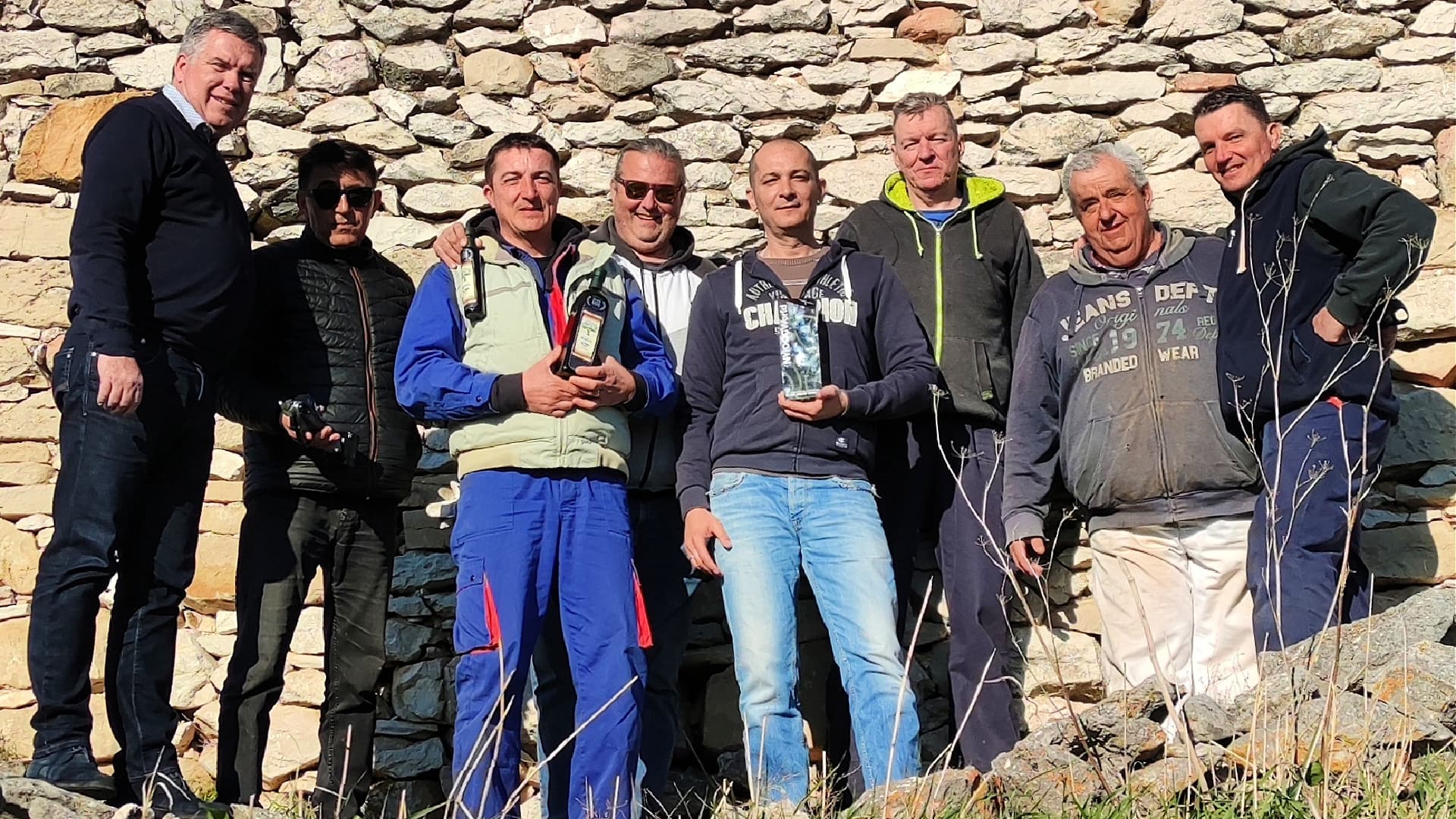
The cousins are helped in the pruning process by friends from Zagreb, turning this time of year into a festive one in their olive groves.
“There is nothing better than socializing. Because we have been learning from each other for a long time,” Zoran Crnomarković, one of the friends who helps in the groves, said.
Others including Renato Kovačić, Almir Halilagić, Tihomir Perkovic and Marin Mišura feel the same way.
During a brief break from pruning, the friends gathered at a table next to two stone houses to enjoy local delicacies, including suckling pig, beans, wine, beer, various cakes.
Along with expanding their groves, the cousins are renovating the stone houses on the property and intend to decorate them in the traditional Dalmatian style.
They also anticipate receiving €165,000 in European funds for rural development, part of which will be dedicated to renovating the old stone houses and restoring the region’s architectural heritage.
“After we renovate the houses, we will spend even more time on the property,” Koša said. “Guests will also come to taste our oil. We intend to combine olive growing and tourism.”
Koša will be joined in the olive grove this summer by his parents, wife and daughter. The family will work in the olive grove in the morning or evening. The rest of the day will be spent by the sea in Pirovac, where they have a cottage.
“From Perušić to Pirovac is 24 kilometers. The same as between the two neighborhoods (from Dubrava to Sesvete) in Zagreb,” Koša said.
Mišura will also be joined by his family, who also have a cottage nearby, and will join them in both work and recreation.
While the cousins have enjoyed plenty of the rewards of olive growing, this has not come without its challenges, especially the ongoing drought in the region and increasingly hot summers.
As a result, they have developed new irrigation systems this summer. Water from the nearby Lišani Ostrovicki is pumped into a 15,000-liter system of cisterns.
The first arrives in a 5,500-liter rubber tank, located in a stone house, so the intense heat does not deform it. There are three more external storage tanks, each with 3,500 liters of water.
The tanks are connected with an outlet pipe through which the water flows down to the drips arranged around each olive tree.
“We have a natural slope of about five meters, and the terrain with seven rows of olive trees is 230 meters long, so there are no problems with water flow,” Koša said. “Around each tree are three drippers of four liters of water per hour, so together they give each olive tree 12 liters of water.”
“It is better to water intensively once than several times less, which is of little use because it is too dry, so the water does not reach the roots,” he added.
However, the cousins’ olive groves are protected from the wind. The trees stretch along a southern slope, shielded from the strong north winds but exposed to constant airflow. This dramatically reduces the chances of attacks by diseases and pests. As a result, the cousins rarely spray olives, using organic pesticides when they do.
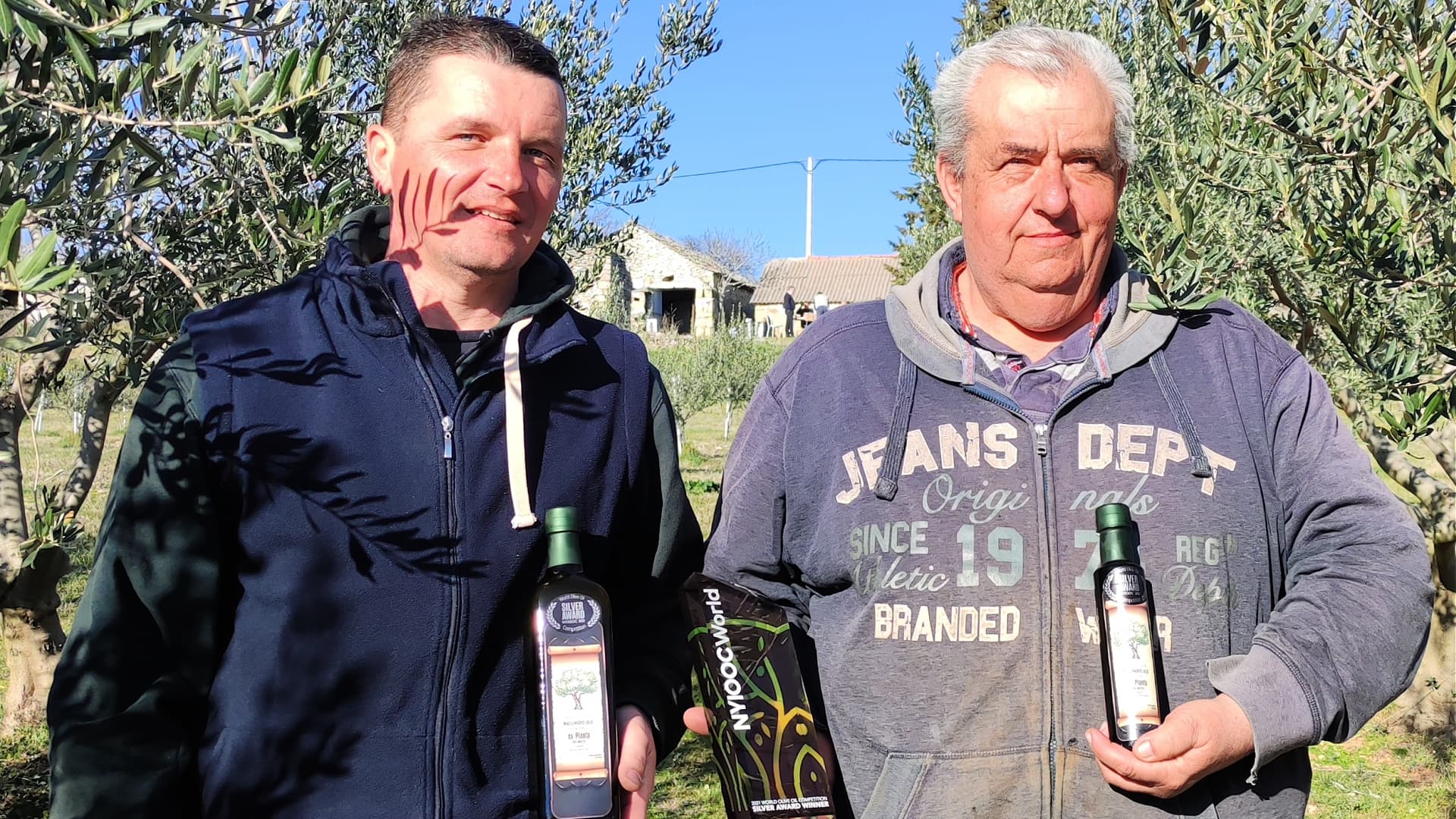
“The fruits of our olives are healthy, so the oil is of good quality,” the cousins said. The two have won various local awards for their extra virgin olive oils and earned a Silver Award for their Oblica monovarietal at the 2021 NYIOOC World Olive Oil Competition.
“To win an award at such a prestigious world competition is every olive grower’s dream,” the cousins said.
This year, the cousins plan to enter a blended extra virgin olive oil, comprising Oblica (60 percent), Krvavica (30 percent) and Leccino (10 percent). The oil is already on its way to New York, and the cousins are hoping for Gold.
“Hope is not forbidden,” Koša said with a characteristic smile. Along with other producers, he hopes to repeat last year’s result when Croatians earned 67 Gold and 20 Silver Awards at the NYIOOC.
In the meantime, Koša and Mišura will continue to grow their olives, renovate the stone houses and dry stone walls and gather relatives and friends in the olive grove.
“We combine the pleasant with the useful,” Mišura concluded.