Olive Oil Sommelier Unites Quality Producers in Tuscany
Entimio founder, Daniel Santini, is bringing together a group of Chianti’s top olive oil producers under a single brand.
“What I had in mind was a lifestyle brand focused on people, territory and excellence,” Daniel Santini, the founder of Entimio, told Olive Oil Times. “We have done even better, creating an ecosystem of aware consumers and artisanal producers linked in a trustful and respectful relationship.”
Santini was born and raised in Tuscany, but currently resides in the United States. He spent almost 20 years working in finance, before beginning a second career in olive oil.
Each of our bottles must be a memorable experience.
“I was a careful consumer who worked in the corporate world,” he said. “As my passion for quality food increased, I felt a natural wish to learn more about extra virgin olive oil, and I understood that there was still room for products of excellence.”
Eager to learn more about the world of olive oil, he attended tasting courses in Italy and the U.S., where he completed the Olive Oil Sommelier Program organized by the Olive Oil Times Education Lab and the International Culinary Center. In 2017, his hard work and passion paid off, culminating in the creation of a new company.
See Also: Producer Profiles“For the launch of my project, I tasted and selected some of the best productions in Chianti and invited the farmers to join the Entimio brand,” he said.
Every year since a small group of high-quality Italian producers have taken part in this ambitious project and received multiple awards at the NYIOOC World Olive Oil Competition.
Among these is the Losi family, whose work and story lie behind the quality of the Gold-award winning Entimio Intenso Chianti Classico PDO.
“We are the fifth generation of producers, and our aim is to make excellent products strongly linked to our territory,” Riccardo Losi, who works with his sister, father and uncle to manage the farm and market their olive oil, said.
The first taste of the Losis’ extra virgin olive oil marked the beginning of a fruitful partnership with Santini.
“When I sipped it, I knew I had found a unique gem to treasure and share with the world,” he said.
In Castelnuovo Berardenga, north of Siena, the Losi Querciavalle estate is nestled on the slopes of the Pontignano Charterhouse. In 1700, monks planted an ancient type of Correggiolo olive tree on these same slopes, which has been preserved to this day.
“Our family put down roots here 150 years ago, in 1870, and part of the grove dates back to this time, when our ancestors reproduced the plants of the Charterhouse by cutting,” Pietro Losi, Riccardo’s father, explained. “In the 1950s, our grandfather, Tranquillo, used the same method, obtaining more clones of those olive trees, and now we keep doing that with each new plant.”
On the hills of Chianti at an altitude of between 280 and 350 meters (918 and 1,148 feet), the old Correggiolo plants are flanked by Frantoio, Leccino, Moraiolo and other unidentified ancient varieties, reaching a total 3,000 olive trees.
The estate, which includes large wooded areas and several hectares of vineyards, enjoys plenty of exposure to the sun and rich calcareous topsoil. Below, the valley floor soil is characterized by the presence of tuffaceous rocks.
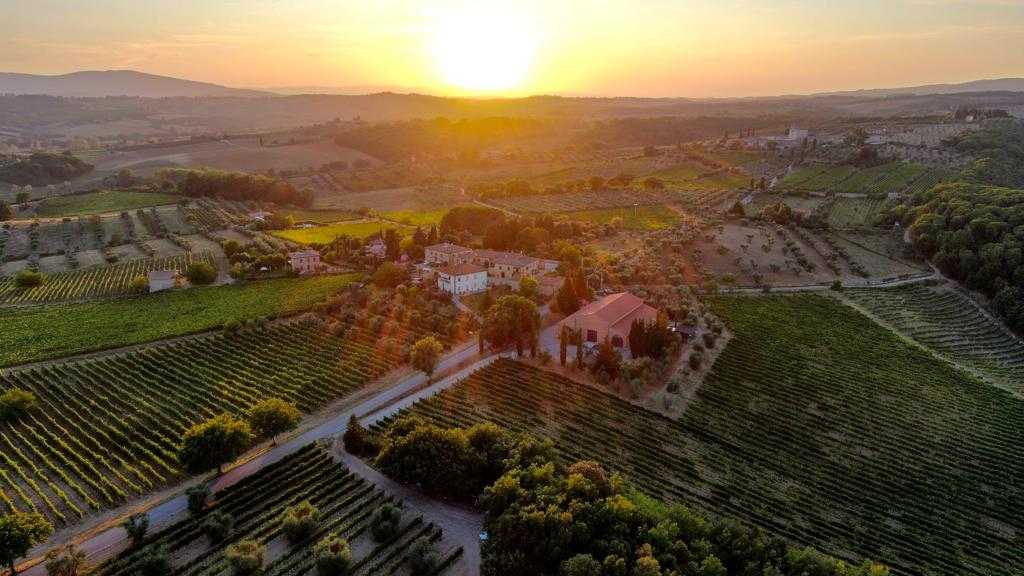
The Losi family’s Querciavalle estate in Tuscany’s famed Chianti region.
“The oldest parts of our groves are arranged according to an extensive planting layout,” Losi said, specifying that many plants are located at a distance of 10 meters (32.8 feet) from one another. “In the past, the space between the rows was used to grow crops such as wheat and barley, now we practice mixed cropping with vines.”
Native grape varieties such as Canaiolo, Malvasia, black Malvasia, Trebbiano, Colorina and some Merlot are interspersed among the olive trees, some of which are kept wild and help maintain coolness and humidity in the biannually-ploughed soil.
“Polyculture requires a lot of attention during plant health care operations since we apply a zero-residue method,” Riccardo Losi said. “Respect for the environment is fundamental, not only to obtain good products but also to encourage the presence of beneficial insects in the orchard.”
“On the other hand, thanks to the excellent position, the problem of pests such as the olive fruit fly is almost irrelevant,” he added.
After major freezes in 1956, 1985 and 1995 many of the family’s olive trees underwent drastic pruning, performed by Riccardo’s grandfather, in order to repair the frost damage.
“He taught me all about his work and these plants, which I am passionate about,” Losi said. “That passion, handed down from generation to generation, also touched the heart of my young daughter, who already loves the pungency and bitterness of our extra virgin olive oil.”
Notwithstanding the strong ties with tradition, the Losi family has always followed the evolution of production techniques and methods.
“We moved from using a traditional mill to the continuous cycle mill in the mid-90s,” Paolo Losi, Riccardo’s uncle, said. “We constantly improve our production process, and we currently partner with a two-phase mill, equipped with the latest technology, to get best out of our fruits.”
In order to preserve the organoleptic and chemical properties of the products obtained by the farmers, Entimio laid down high safety and conservation standards.
“Each of our bottles must be a memorable experience,” Santini said, adding that the adoption of an argon blanketing system preserves the features of Entimio’s extra virgin olive oil in the bottle.
“We strive to achieve the best quality at the point of consumption, and we are willing to sacrifice profit to satisfy our customers,” he said. “They know the difference that an authentic premium product can make in their life in terms of taste and health benefits.”
“Farmers like Losi support Entimio in being an uncompromising source of authentic extra virgin olive oil,” Santini concluded, while a black rooster, the symbol of the Chianti Classico PDO, vigorously crowed from the barnyard adjacent to the olive grove.